It is easy, in deer management, to become consumed by the immediate. Wind, access, backstops, public pressure, wet ground, the simple reality that you can do everything right and still come home with nothing in the chiller.
The work is practical, physical, and often solitary. Yet the consequences of doing it well, or badly, reach far beyond any single outing. They show up in woodland condition, in regeneration failure, in collisions on roads, in animal welfare outcomes, and in the trust the wider public places in countryside work.
That is why we believe it matters to partner not only with government departments and agencies, but also with universities and research bodies, and to support studies that are trying to improve how Britain manages the relationship between deer, ecosystems and people. Good policy cannot be built on ideology alone. Equally, field practice cannot rely only on inherited habit and local folklore. The best outcomes come when evidence and experience sit in the same room, and when the people writing frameworks understand the constraints and realities of delivery on the ground.
Good policy cannot be built on ideology alone.
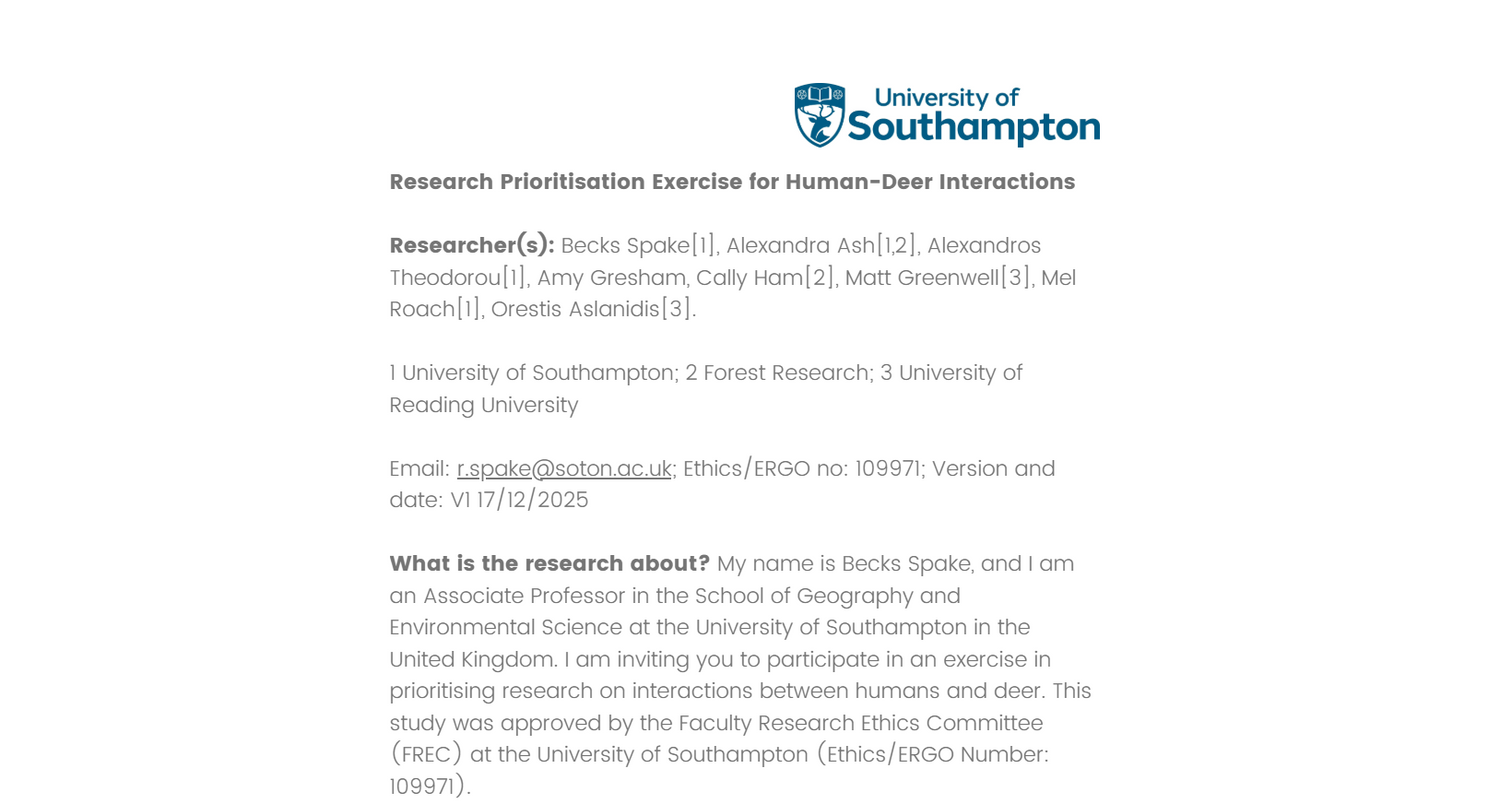
We were recently asked to contribute to a national Research Prioritisation Exercise focused on human-deer interactions in the British Isles, led by TreeLab at the University of Southampton in collaboration with Forest Research and the University of Reading. The purpose is simple, and it is the right question to ask: what research questions, if answered, would most improve policy and practice relating to deer, for the benefit of people and nature? That kind of exercise matters because it shapes what gets studied, what gets funded, and ultimately what becomes “best practice” in future guidance, licensing, grant design, and land management expectations.
From our perspective, the most important part is ensuring the voice of those actually managing deer is present and taken seriously. Deer managers, keepers, stalkers, rangers, foresters, land agents, and landowners are the ones who see outcomes up close. We see what works, what fails, and where standards slip under pressure. We understand how deer move between holdings, how disturbance changes behaviour, how public access affects safe delivery, and how quickly a seemingly minor design decision in a scheme can produce unintended consequences in the field. That perspective is not a replacement for science. It is the context that makes science useful.
There is also a professional point here that is often missed. Supporting research is part of maintaining credibility. Deer management is increasingly delivered on sensitive, public-facing ground. It is commissioned by organisations with duty-of-care obligations and reputational risk. In that environment, being able to say that your approach is evidence-led, that you contribute to the wider understanding of impact and welfare, and that you are willing to be scrutinised, is not a nice extra. It is part of what professionalism now looks like.
This is not about chasing influence, and it is not about handing responsibility over to academics. It is about shared responsibility. Universities bring rigour. Forest Research brings applied science and continuity. Government and agencies bring accountability and implementation pathways. People on the ground bring realism, pattern recognition, and the operational truth of what is achievable, safe, and proportionate. When those perspectives are separated, we end up with mixed messages, frustration, and avoidable conflict. When they are aligned, we get clearer standards, better targeting of effort, and outcomes that can actually be measured in habitat response and welfare improvement.
If you manage deer, especially in areas where the work is complex and visible, your input matters. Research prioritisation only works if it captures the real questions, not just the tidy ones. If you would like to feed into this kind of work, or you want to understand how we are engaging with studies like this, feel free to reach out. The long game in deer management is not simply cull numbers. It is building a system where good practice is supported, understood, and capable of standing up to scrutiny, for the benefit of the landscapes we work in and the species we manage.