The British Shooting Show is always a useful place to separate marketing from reality. You see the latest kit, you meet the people behind the counters, and you catch yourself asking the only question that really matters: would this earn a place in the truck on a wet Tuesday in February, or is it destined to live a comfortable life on a rack and at the range.
Blaser has been part of my working life for a long time. I run two parallel Blaser 6.5x55s and they have accounted for more deer than I care to count, across vineyards, airports, golf courses and Sussex woodland. They have been carried, knocked, soaked, and still delivered what a working rifle should deliver. I am not looking for reasons to criticise them. Quite the opposite.
Which is why it was disappointing to walk away from their stand this year feeling slightly deflated, twice.
This is not a verdict, and it is certainly not a call to abandon the brand. It is a snapshot from one show, from one stalker who uses the kit in real British conditions, trying to work out whether the next wave of design is moving towards the realities of deer management, or drifting away from it.

The stand: atmosphere and engagement
Shows are busy and tiring for everyone. Staff are on their feet all day, repeating the same conversations, and I do have sympathy for that. Even so, there is a baseline expectation that when someone walks onto a stand with clear intent, they are acknowledged without having to cut into a staff huddle.
On the Blaser stand that did not happen. Several staff were grouped together in conversation and it took a deliberate approach and a direct question to break into that circle. No proactive greeting, no simple “you alright there” or “can I help”. For the largest, most visible stand as you walk in, it felt like a missed opportunity.
I am not looking for special treatment because we are there as press. I am not interested in a red carpet. What I do expect, especially from a brand that has a loyal base of working stalkers, is curiosity about real use. What has changed, why it has changed, what problem it is trying to solve, and how it stands up to damp woodland, bracken, and the kind of constant handling that comes with commercial contracts. Other stands managed that instinctively. They opened the conversation, put product in hand, and asked what we do before launching into features.
A show interaction is not the whole brand, but it is often a person’s first point of contact. A hesitant welcome plants a seed of doubt that glossy marketing does not always undo.

The R8, and the new adjustable cheek piece
The rifle that still draws most attention is the R8. Straight pull, modular barrel system, proven accuracy, and a safety concept that many people trust. You could make a strong case it remains one of the best stalking platforms available, particularly when kept simple: sensible barrel, robust stock, good glass, nothing that does not earn its keep.
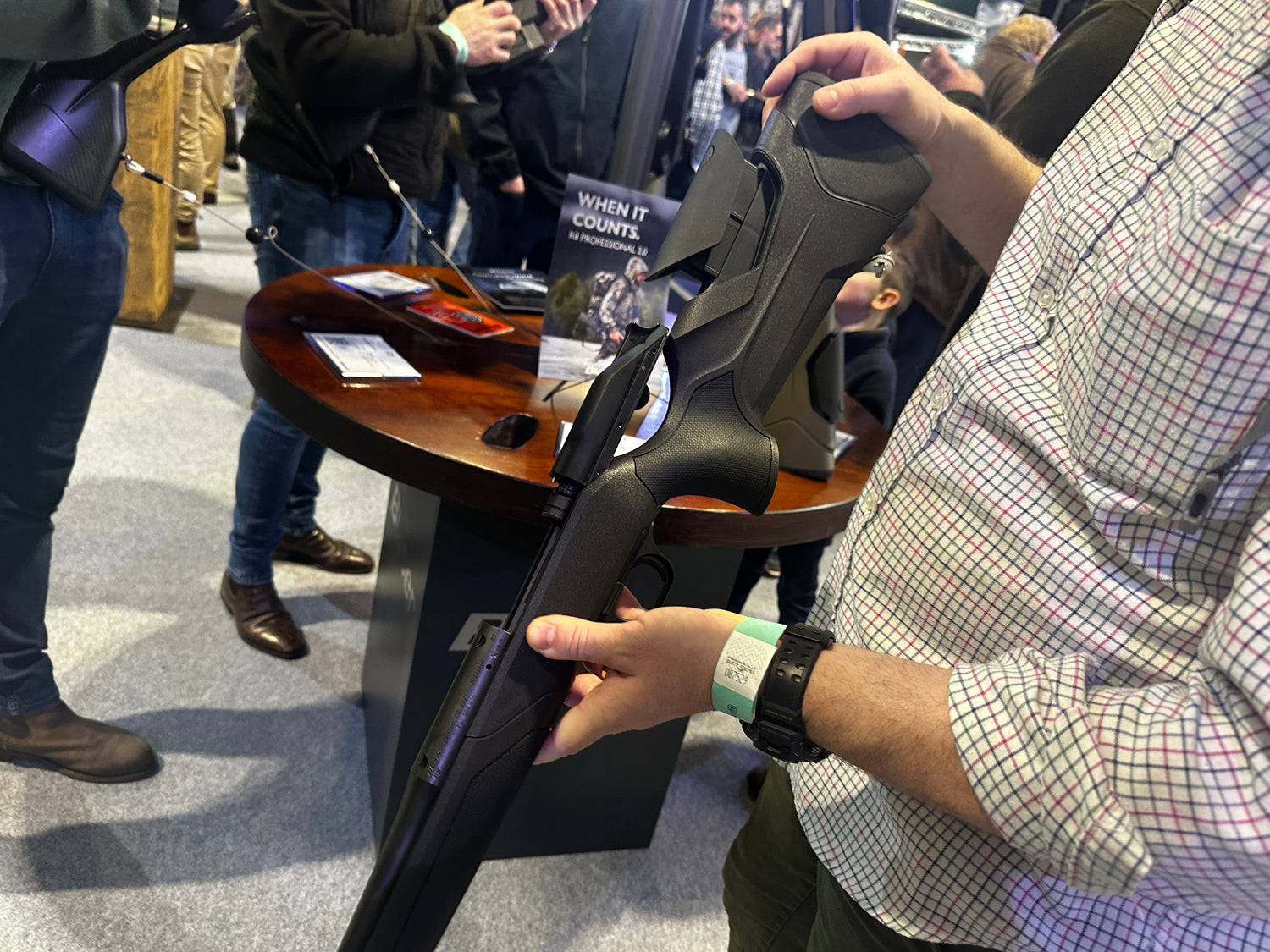
The new stock with an adjustable cheek piece is clearly aimed at better ergonomics and repeatability, especially when running larger optics or higher scope mounts. In principle, that is understandable. Faces differ, scope heights differ, and a consistent cheek weld can improve consistency.
The question, though, is never whether an adjustable comb feels comfortable under NEC lighting. The question is whether that mechanism still works cleanly after two seasons of being dragged through bracken, mud, blood and grit, after a knock off a high seat ladder, after being shoved into a truck and pulled back out in the rain. That is the environment in which professional deer managers will test it, and it is where doubts start to creep in.

Field use and moving parts
On day one, when I raised concerns about durability and ingress around the cheek mechanism, the first answer was essentially “just close it”. On one level, yes. If you buy adjustability and decide you do not trust it, you lock it down.
But that response misses the point. Every moving part on a working rifle is a potential failure point, and not in a dramatic way. More often in the slow, irritating ways: grit working into tolerances, damp sitting where it should not, a mechanism becoming stiff, noisy, or reluctant just when you need it to behave. Slides, clips and cavities do not exist in a clean vacuum. They live in wet Britain. They live in woodland. They live with dried blood and bracken spores and fine sand, and with hands that are cold and tired.
But that response misses the point. Every moving part on a working rifle is a potential failure point, and not in a dramatic way
On day two I pushed the question again, with someone a little more engaging. The sense was that they had not heard concerns, and when I asked about water ingress and sealing, particularly when closed, the practical answer was essentially that you would let it dry out.
That is not an answer that works for us in the South East when you are running a rhythm of morning and evening sessions for weeks on end and “drying out” is not a reliable phase of the season. You can come home, wipe down, air kit, do everything properly, and still be back out in damp woodland the next evening. If a design expects ideal downtime, it is already at odds with the reality of professional use.
Maybe I am overly protective of a tool I have trusted for years, but it does feel like Blaser is at risk of drifting away from one of its quiet strengths: a rifle that, in its simpler configurations, behaves like a hard, dependable workhorse.

Show rifles versus working rifles
This is the tension many manufacturers face. Adjustable features and technical language look good on a stand. They signal progress. They photograph well and they sell the idea of “optimisation”.
Working rifles, however, earn their reputation in silence. Nobody sees the fifth wet outing of the week, the extraction across a churned-up field at midnight, or the moment where you need to solve a minor issue in the dark with numb hands. Those are the moments that decide whether a design is sensible or indulgent.
Maybe I am overly protective of a tool I have trusted for years, but it does feel like Blaser is at risk of drifting away from one of its quiet strengths: a rifle that, in its simpler configurations, behaves like a hard, dependable workhorse.
For me, the gold standard is not whether a stock looks clever, but whether it stays quiet and solid after years of rough use, and whether it can be cleaned and trusted without fuss. That is where my unease about an adjustable cheek piece comes from. It is not an aesthetic objection. It is a field one.
The Blaser strengths still matter
None of this erases what Blaser still does exceptionally well. The core R8 platform remains strong. Accuracy, modularity, the straight pull action, and the way the rifle handles are hard to fault. In my experience the action has been tolerant of hard use, and the barrels I have run have been consistent and predictable, which is exactly what you want when you are on contract work and you cannot afford surprises.
Blaser also understands balance and feel. The standard hunting stocks shoulder naturally and sit well in the hand. That matters, especially in the sort of woodland shooting where you are rarely set up like a range bench.
So the criticism here is narrow, but important: I would like to see clearer acknowledgement that there are now two distinct user groups. Recreational users who value adjustability and fine fit, and working stalkers who prioritise simplicity, robustness, and ease of cleaning above almost everything else. The ideal is not one product trying to please both. The ideal is honest options that clearly speak to each type of user.

Service, support, and the value of listening
A brief show interaction is not the entire company, and it would be unfair to claim it is. But it does underline the importance of listening to working users and taking their concerns seriously, even when those concerns do not align neatly with the marketing story.
If someone who has run your rifles hard for years says a new feature might introduce failure points in wet woodland conditions, that is not a nuisance. It is useful feedback. You might still decide to keep the feature, but the conversation should be more than “just close it”. A brand like Blaser has always done well when it learns from the field rather than simply selling to it. I hope that remains the case.
Where this leaves things
So where does that leave me after this year’s show? Still committed to the platform, still clear on its strengths, but more cautious about certain design directions.
For my own work, the simple, robust configuration remains the preferred choice. Solid stocks, nothing that cannot be cleaned or stripped easily. The adjustable cheek piece may suit some users brilliantly, particularly those who value fine fit and spend more time on the range or on driven days. For others, especially those crawling through Sussex bramble, extracting fallow in wet woodland, and running repeated sessions through a damp season, it may be a step too far away from the “no nonsense” ethic that attracted many of us to the brand in the first place.
It comes back to one question I try to ask whenever new kit is released. Will this genuinely help me do the job better on a wet weekday in February, or is it solving a problem I do not have. If it is the latter, it is not an insult to walk on and keep using what already works.
The R8 remains a serious tool. It just needs to be chosen, and set up, with a clear eye on the work it will actually be asked to do.
If Blaser would like me to revisit any of these observations in more detail, or talk through the realities of how their rifles are being used week in, week out on wet, public-facing deer contracts in the South East, I would be more than happy to have that conversation.