There are stands at the British Shooting Show that you drift past, and there are stands that stop you in your tracks. Emberleaf sits firmly in the second camp. Even from the aisle the cabinets look different. Not a wall of identical blades, not a conveyor belt of “new for this season”, but individual pieces that feel closer to a small exhibition than a trade pitch. You do not so much browse as pause, lean in, and then realise you have been there longer than you intended.
What stood out this year was not only the knives, but the people behind the counter. We were first greeted by one of Emberleaf’s apprentices Kalista, who talked us through the work with no script and no performance. It was calm, precise, quietly confident.
In a world where so much kit is designed to be replaced, there was something reassuring about speaking to someone who could explain the tool because they have actually made it.

Materials With a Story
Emberleaf has always operated in a different space when it comes to materials. Yes, there are sensible steels and the sort of finishes you would expect on a working knife, but what draws the eye, and keeps it, are the handles. The workshop seems to enjoy the idea that the material itself should carry a narrative.
Mammoth molar and mammoth ivory show up repeatedly. Stabilised woods sit alongside rarer, more unusual choices. There was even giraffe bone on one particularly striking custom piece, the sort of thing that looks theatrical at first glance until you notice the fundamentals are still there: pinned properly, shaped properly, finished properly, built like a tool that is meant to be used rather than simply displayed.
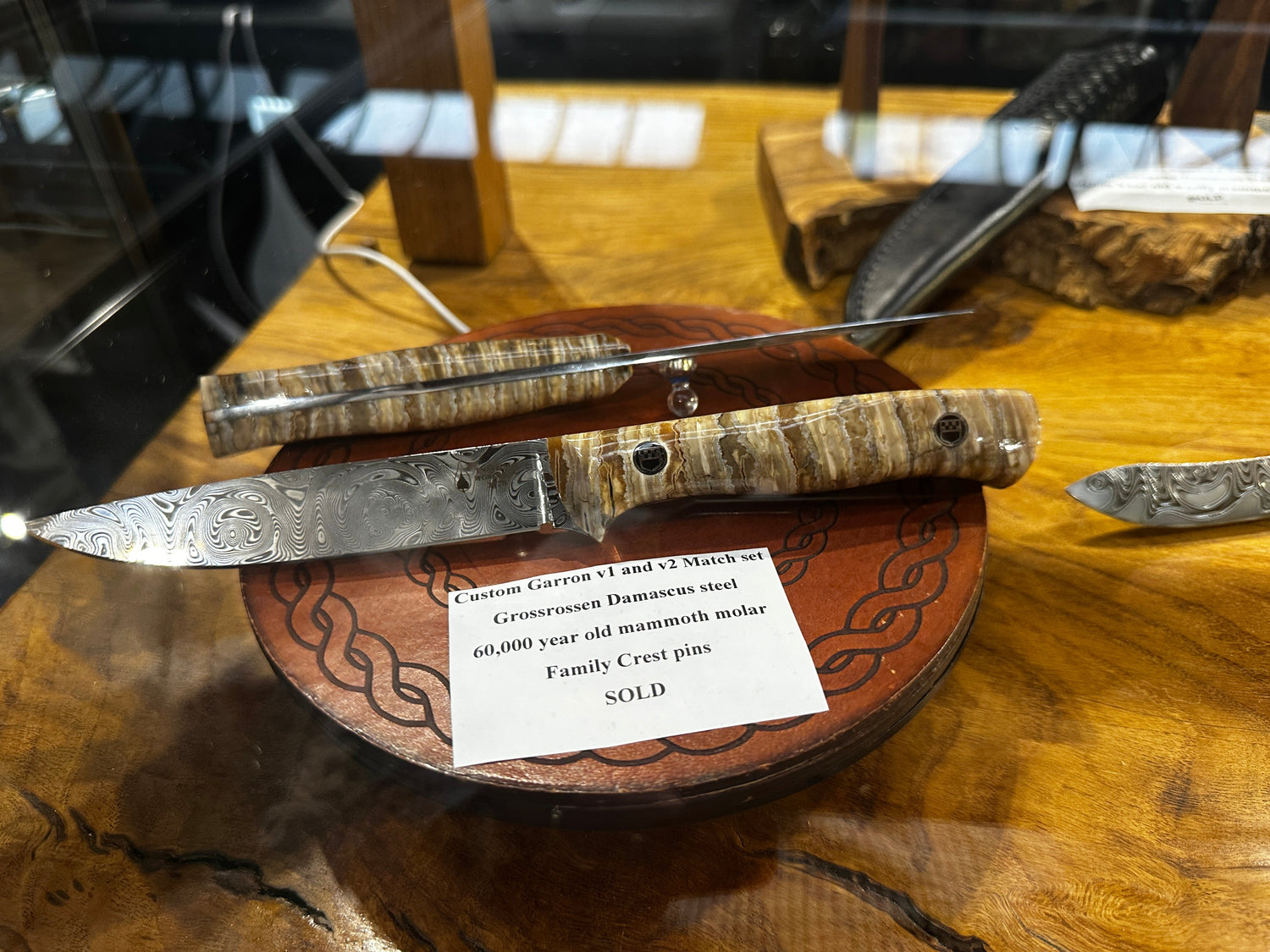
When I asked about her favourite knife, she pointed to a sold custom set that felt like the purest expression of what Emberleaf is doing. Grossrossen Damascus blades, handles built from mammoth molar, finished with family crest pins. Ancient material paired with something deeply personal. In the hand it made sense. A knife like that is not just “a good knife”. It is a story you carry, and if you look after it, a story you can pass on.

Another piece that stayed with me was a special edition using bog oak combined with mammoth bone spacers. Again, already sold. That was a theme. Many of the standout knives are not really “stock”. They are commissions, or they are special pieces that barely touch the shelf before they disappear into the hands of someone who already knows what they want and why.
You can argue that nobody needs prehistoric material in a knife. You would be right. That is not the point. Deer management has a strange relationship with time. We deal in single, irreversible moments on the trigger, set inside woodlands that take decades to mature, and within management plans that aim to influence outcomes long after the current season has ended. A tool built from material older than written history fits that mindset more neatly than it first appears.

The Knife as the Primary Tool
For those of us who stalk and process our own deer, the knife is not an accessory. It is the primary tool once the shot has been taken. Everything from field gralloch to larder preparation and butchery runs through the edge. A cheap knife will do the job for a while, then it will blunt, slip at the wrong moment, get lost, or end up forgotten in the bottom of a bag. It becomes transient.
A well-made knife behaves differently. It invites care. You notice how it enters the work, how it tracks through skin, fascia, and connective tissue, how little force is required when the geometry is right. That detail matters. Good geometry keeps your cuts controlled. Controlled cuts keep your hands safer, your carcass cleaner, and your tempo calmer. You find yourself cleaning the blade properly at the end of an outing instead of leaving it on the tailgate. Gradually it becomes part of your working rhythm, as familiar as your rifle, your binoculars, or the way you shoulder into a seat without thinking about it.
That is why Emberleaf’s approach appeals. The cabinets and polished wood might suggest “collector pieces”, but the proposition underneath is practical. Behind the mammoth and bog oak is serious design. These are knives intended to work. The aesthetic is not there to replace function, it sits on top of it.
I know where my own bias comes from. The knife I carry for most of my work has my son’s name stamped on it. It is not going to be traded, sold, or left behind on a peg. It will either be passed down or worn out through honest use. That sense of continuity matters.
Emberleaf leans into the same principle without dressing it up as anything other than what it is: a tool that can hold memory.

A Warranty That Forces a Different Way of Thinking
At the centre of Emberleaf’s pitch is a warranty that runs to a timescale you do not hear often. You will want to check their own terms for the detail, but the principle matters. You do not offer that sort of guarantee if you think your work is on borrowed time.
A warranty like that is not simply a marketing hook. It is a statement of intent. It says: we expect this tool to outlive you. We expect it to be sharpened, used, resharpened, and handed on. We expect it to become part of a working life, not a short-lived purchase.
For professional users, that matters because we ask a lot of our knives. They are used in rain, blood, mud, and cold hands. They are cleaned hurriedly, sometimes badly. They cut twine, netting, hide, cartilage, and everything else the day demands. If a maker is prepared to stand behind their work in that reality, it tells you something about their attitude.
It also shifts the conversation away from shallow price comparison. Yes, an Emberleaf costs more than a catalogue knife. It is supposed to. The honest comparison is not two numbers on a receipt, it is the difference between something forgettable and something that may still be doing its job in a grandson’s hands.

Meeting the Makers
Among the materials and finished pieces it would be easy to overlook the human side, but that is where the real value sits. I had a brief chat with Dean, one of the founders. We have spoken before, and the thing that strikes you each time is how grounded he is. No affectation. No attempt to play the celebrity maker. Just a craftsman who still cares about each knife that leaves the workshop.
That attitude runs through the team. The apprentice who guided us through the range knew the detail, not because she had memorised a script, but because she has been there doing it. When someone early in their career can explain how the handle is pinned and shaped, you get a sense that the workshop culture is healthy.
In an industry where products are often designed in one country, manufactured in another, and sold by someone who has never held the raw material, there is something quietly reassuring about speaking to the people who have actually built the tool. If there is a question about care, sharpening, or use, you are not dealing with guesswork. For working stalkers, that direct relationship matters more than another line of copy.
Why This Matters to Deer Managers
It is easy to look at high-end knives and see indulgence. For some people, that is exactly what they will be. There is nothing wrong with that, but for those of us who live with a knife on our belt, the conversation is deeper.
For professional users, that matters because we ask a lot of our knives. They are used in rain, blood, mud, and cold hands. They are cleaned hurriedly, sometimes badly. They cut twine, netting, hide, cartilage, and everything else the day demands. If a maker is prepared to stand behind their work in that reality, it tells you something about their attitude.
Deer management asks for consistency. Rifles, optics, vehicles, larders, all of it sits inside a framework of safety and responsibility. The knife belongs in that same circle. A dependable knife makes grallochs cleaner, carcass preparation safer, and field work more efficient. Better geometry means less force. Less force means fewer slips. Steel that holds an edge reduces interruptions and keeps the work calm rather than rushed.
There is also a quieter psychological aspect that people rarely admit. When your tools are in order, your head tends to follow. Turning up on an estate with kit you trust, and a knife that has already proven itself, sends a different signal to the landowner and to you. You are not improvising. You are not making do. You are operating with intention.
Emberleaf is not the only route to that standard, but it is a clear expression of it. They take a simple, ancient idea, a cutting edge, and treat it with the seriousness it deserves.
In Reflection
Walking away from the Emberleaf stand this year, what lingered was not simply the memory of mammoth handles or Damascus patterns, but the sense that some corners of the countryside world still hold to an old-fashioned idea: build something once, build it well, and expect it to serve more than one lifetime.
In a culture that churns through gear at an alarming rate, that approach feels quietly radical. For those of us who see knives as working partners rather than disposable accessories, it is encouraging.
If you have not yet come across Emberleaf Workshops, they are worth your attention. Whether you are in the market for a new primary knife or simply interested in what serious craftsmanship looks like when it is still anchored to function, they offer a reminder that tools can carry weight, story, and responsibility, not just a cutting edge.
You can visit their website here: https://emberleaf.com/