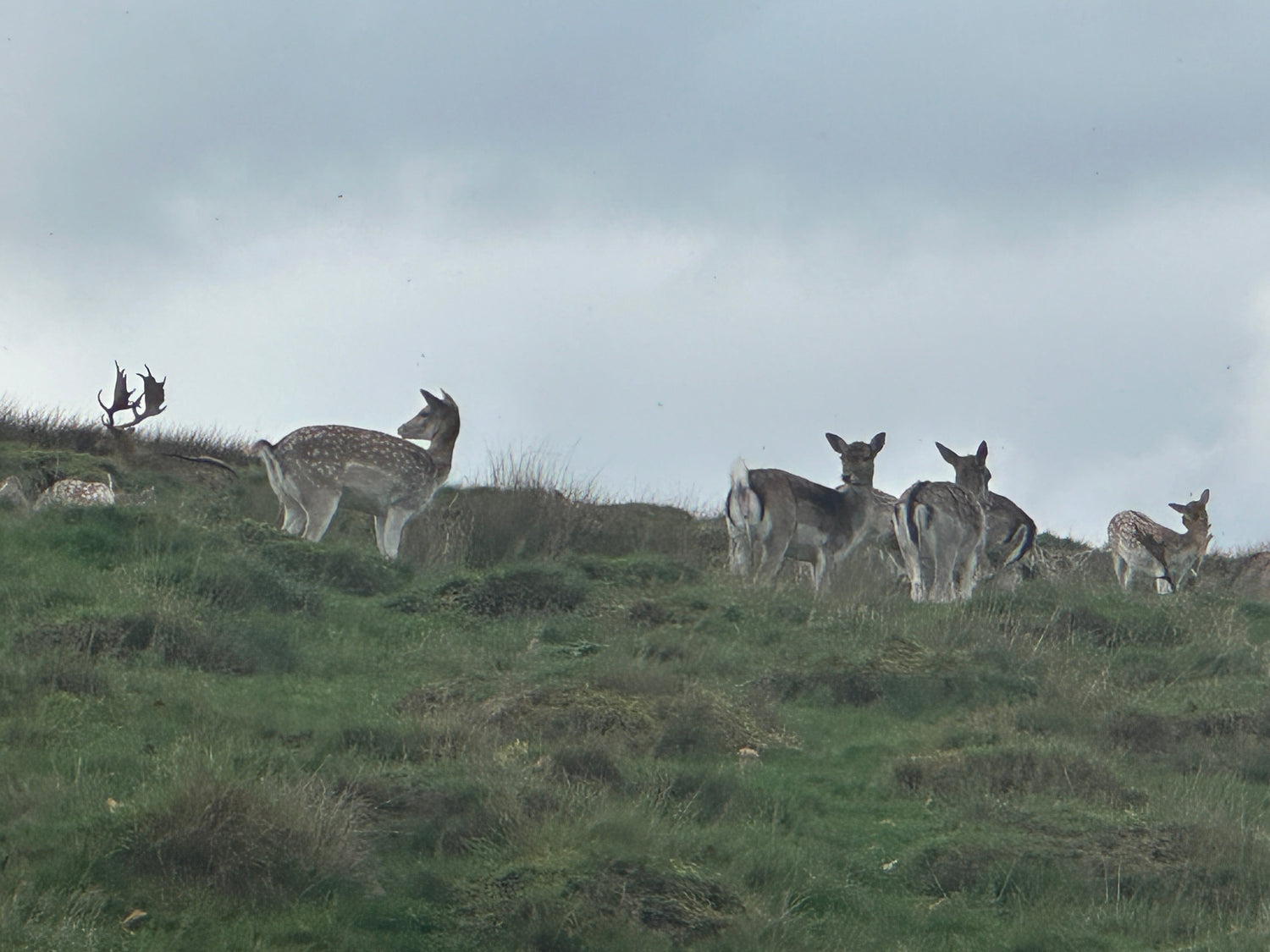
Deer are easy to treat as background. They are part of the scenery, part of the story an estate tells about itself, part of what visiting friends expect to see in the park or across a ride at last light. Because they are familiar, and often attractive, it is tempting to think of them as benign until there is an obvious crisis. People photograph them, point them out to children, and weave them into the identity of the place.
The trouble is that deer rarely cause crisis in a dramatic way. They do not arrive overnight in a way that forces an obvious decision. They work slowly, season after season, from the ground up. Estates that ignore them or play at managing them discover, usually too late, that the real cost has been accumulating in the soil and the understory for years. On the surface, nothing appears dramatically wrong. Underneath, the system is quietly failing.
The Slow Erosion of Woodland Value
When deer numbers creep above what the habitat can carry, the first casualties are not the big trees. Mature stems can stand for decades while the damage is done beneath them. The first things to go are the easiest to overlook: seedlings, saplings, shrubs, the varied herb layer that should make up the living fabric of the woodland floor.
Regeneration that might have formed the next canopy is grazed down repeatedly until it gives up. Each winter, deer take off the new growth at precisely the height they can reach. A sapling that should be racing towards the light is held forever at knee height, or simply dies back. Sensitive plants that cannot tolerate constant browsing simply vanish. What remains are the few robust species that can cope with the attention, or that deer find unpalatable. Over time, the entire character of the wood shifts towards a narrow, impoverished community.
Walk through a wood in that state and it can still feel impressive at first glance. The ride is tidy. The light patterns are pleasant. The canopy, viewed from the track, looks healthy. Yet if you look closely, there is almost nothing between the leaf litter and your chest. No young trees coming through in numbers. Very little in the way of shrubs. A ground flora that repeats the same few plants again and again. The future of the wood has been quietly taken away while everyone was admiring the present.
From an estate perspective, that is capital lost rather than income forgone. The option to harvest in a particular way in twenty or thirty years disappears, because there is no next crop coming. The flexibility to thin, to manage for quality, to switch objectives as markets or policies change is gone. You are left with ageing stands and very few choices. The capacity to present the wood as an example of good practice when grant inspectors or potential partners arrive is undermined. Claims about biodiversity ring hollow when there is nothing in the understory to support it.
The deeper cost is one of credibility. You cannot honestly talk about sustainable woodland management if you have presided over the quiet removal of the next generation of trees and much of the ground flora. And yet that is exactly what happens when deer are given a free hand.

Planting Schemes Undermined Before They Begin
Where estates put in new planting, the effect of ignoring deer is more immediately visible, but no less insidious. Young trees are the path of least resistance. Tubes are bitten off at the top. Guards are pushed over or rubbed against until they lean and crack. Saplings are stripped of buds and side branches. In some compartments you can almost follow the deer as they work along the rows.
Whole areas that were costed, mapped and proudly photographed for grant applications fail to establish properly. The aerial imagery looks fine. On the ground, too many tubes contain dead stems or stunted, twisted growth that will never make a decent tree. Replacements are ordered. Staff or contractors are pulled off other jobs to restake, re guard, replant. The second wave performs little better because the underlying pressure has not changed. In some cases, enthusiasm for planting is quietly withdrawn. People say that “trees do not like this ground” when in truth the deer like it too much.
Financially, that sort of failure is punishing. Money spent once on creation is spent again on repair, often with diminishing morale. Staff who should be moving on to new projects are dragged back to rectify old ones. Opportunities to join new schemes or extend existing ones are missed because nobody has the appetite to repeat the experience. Relationships with grant bodies and advisers become strained. On paper, the estate looks committed to woodland creation. On the ground, it is running to stand still.
There is also a broader reputational cost. Estates talk about climate, carbon and habitat creation. If visiting foresters or partner organisations find rows of failed tubes and obviously hammered planting, they learn more from that than from any policy document. It sends a message that ambition was not matched by discipline.
The painful irony is that a fraction of the money, time and attention spent on controlling deer at the outset would often have secured the original planting. Thinning numbers, planning access, using high seats sensibly, bringing in night work where necessary, putting a simple impact survey in place before the first spade went in: these are modest investments compared with the cost of trying to fix a planting that has gone wrong. When deer impact is ignored, delay does not just preserve the problem. It multiplies the bill.
Crops, Damage and Quiet Resentment
In mixed estates, deer rarely confine their attention to woods. They move onto crops wherever there is an easy edge or a habit they can build. Winter cereals near woods, oilseed rape, young maize, brassica cover crops, even beet tops: all can become part of the nightly circuit.
The damage is often patchy and therefore easy to dismiss if you only drive by. A bit of nibbling here, a strip taken there, a corner hammered where a hedge offers cover. Over a season, and across several fields, it adds up to something more serious. Yields drop slightly in fields nearest cover. Headlands look ragged. Particular blocks underperform year after year. Nobody is quite sure why, or at least nobody wants to admit it.
Farm tenants may mention it once or twice and then stop, assuming nothing will change. They are used to deer being “part of the place”. The relationship with the owner cools slightly at the edges. There is no row, just a quiet sense that one party is not carrying their share of responsibility. Margins that were already tight are squeezed further by a problem that nobody seems willing to treat as serious. In time, decisions about tenancies, rotations and capital investment are influenced by that experience, whether anyone acknowledges it or not.
Ignoring deer in this context does not only hurt trees. It erodes trust. It says, without needing to put it into words, that the aesthetic value of seeing deer in the park trumps the tenant’s need for viable crops. Over years, that corrodes the working culture of the estate.

Public Access, Safety and Perception
On estates with public access, the costs of inaction are not just ecological or economic. They are also reputational and, at the edges, legal.
Where deer numbers are high and behaviour is altered by constant low level feeding near tracks and car parks, close encounters between animals and people become more common. Deer that have learned to browse in gardens at the fringes of the estate, or to stand on roadside verges in full daylight, behave differently from those that are kept wary by regular, measured control. They linger near paths, cross roads more frequently, and sometimes approach people more closely than is comfortable.
Traffic collisions rise quietly. A few each year at first, on the usual bends, then more as numbers increase. Damage to vehicles, shaken drivers, the odd injury. Gardeners on the boundary spend more money trying to defend shrubs and vegetables. Dog walkers, thrilled at first to see deer, begin to complain when their animals give chase or when deer stand their ground.
All of these experiences feed into how the wider public feels about deer and about the estate itself. If nothing appears to be happening in response, resentment grows. The estate begins to be seen as failing to manage its responsibilities. The narrative is no longer of a well run landscape with deer as part of the picture. It is of a place that allows a problem to spill over into its neighbours’ lives.
If, at the same time, efforts are later made to reduce numbers under licence, the contrast between years of apparent inaction and sudden visible control is sharp. People are more likely to object to culling that appears to come out of nowhere than to a steady, long term approach that has always been part of the management story. Social media amplifies partial accounts. Photographs of carcasses or of stalkers seen from a distance are shared without context.
Ignoring the issue until it becomes acute often means tackling it later in an atmosphere of distrust. You are forced to make harder choices about night shooting, larger culls and tighter access controls precisely when your social licence to operate is at its most fragile.
Cultural Drift and Lowered Standards
There is another cost that is harder to measure but very real. When an estate lives for years with obvious deer damage and does nothing serious about it, people adjust their sense of what is normal. Woods that are browsed out become the reference point against which other woods are judged. Planting that is fifty percent successful is described as “not too bad in these parts”. Tenants and keepers who raise concerns are seen as negative rather than observant.
Once that lowering of standards has taken hold, it is harder to reverse than any population of deer. New staff arrive and are inducted into a culture that tolerates failure. Old staff stop speaking up. Owners stop walking awkward corners of woodland where the reality is most evident. Everyone drifts into an unspoken agreement not to look too closely.
At that point, the estate has not only a deer problem but a psychological one. It has lost the habit of honest scrutiny. Rebuilding that habit later takes more than a few policy changes. It requires someone to step into the discomfort deliberately and say, in effect, that what has been tolerated cannot be allowed to continue.
The Eventual Bill
Taken together, the costs of ignoring a deer problem are paid in several currencies: lost woodland potential, failed plantings, damaged crops, strained tenant relationships, public unease, lowered internal standards and, eventually, the need for more drastic action when the situation can no longer be glossed over.
By the time that point is reached, numbers are higher, patterns of movement are more established and the work required to bring things back towards balance is heavier and more visible. Night licences may be needed where they could have been avoided with earlier action at dusk and dawn. Large culls may have to be carried out in a short window, drawing more attention and controversy than a quieter, sustained approach ever would. Whole beats may need fencing at great cost simply to give woods any chance of recovery.
The very thing that many owners fear a visible, disruptive shift in how deer are handled becomes harder to avoid. Instead of being in control of the narrative, deciding calmly how to explain a measured plan, the estate is on the back foot, justifying emergency measures while neighbours and visitors ask why nothing was done sooner.
Early, modest, consistent control rarely makes headlines. It is exactly that quality that makes it effective. The estate absorbs the cost in manageable, predictable portions rather than being hit by a reckoning years later. Deer numbers are kept within the limits of what the land can bear. Planting, crops and public expectations are all managed in a way that feels steady rather than crisis driven.
Choosing to See the Problem
The first step in avoiding those long term costs is simply choosing to see deer as an active force rather than a passive backdrop. That sounds obvious, but in practice it requires a deliberate act of attention.
It means walking woods with eyes open to what is happening at knee height rather than only at canopy level. It means listening when a tenant mentions damage to margins instead of nodding and moving on. It means noticing when ground flora changes over a decade, or when a favourite compartment somehow never develops any new trees. It means being honest about why planting is not thriving, even if that honesty cuts across comfortable stories about the estate.
From there, building a structured, realistic deer management plan and sticking to it is less dramatic than a crisis response, but far kinder to the estate’s future. That plan will not be perfect. It will need adjusting as you learn more. It will involve compromises between sporting interests, conservation goals and farming realities. It will, at times, be inconvenient.
The alternative is not neutrality. It is a slide into a situation where choices are taken away by events. Either you carry responsibility now, in increments, or you allow it to grow into something heavier and less forgiving later. In that sense, deer management is not simply about animals. It is about what kind of steward you intend to be of the land in your care, and over what time horizon you are prepared to think.