Deer management is full of quiet tensions, most of them invisible to anyone outside the work. One of the more persistent is the question of certificates. Are they a genuine mark of professionalism, or simply training for the sake of training. Do they help the woods and the deer, or mainly keep administrators happy.
It is easy to take a position at one extreme. Some argue that no one should be allowed near a rifle without a full suite of formal qualifications. Others insist that nothing beats forty years of dawns and that a laminated card proves very little. Reality, as usual, sits somewhere less tidy in the middle.
What follows is not a defence of one camp or an attack on the other. It is an attempt to set out why certificates matter in some contexts, why they can feel like an unnecessary burden in others, and how we try to navigate that in our own work.
The view from forty seasons
Begin with the person who has been doing this for longer than many trainees have been alive. A keeper who has managed ground since leaded petrol. A stalker who has watched the same rides, the same high seats and the same family lines of deer for decades.

Ask that person to sit an exam written by someone half their age, in order to prove that they can tell a fallow doe from a young buck at seventy metres on a slide, and you should not be surprised if they bristle. They have survived forty seasons not by accident but by judgement. They have pulled thousands of triggers without incident, often with responsibilities and workloads few modern managers will ever see.
From that vantage point, the demand to produce a certificate can feel insulting. There is a background suspicion that the paper is being used as a shortcut by people who do not understand the reality on the ground. The older practitioner is asked to prove competence to someone whose only real credential is that they have completed the right course.
You can understand the irritation. You can also understand the anxiety beneath it. There is a fear that the craft is being replaced by a checklist, and that lived experience is being quietly discounted in favour of whatever the current syllabus happens to include.
The view from the regulator and the sensitive site
Now turn it around and look from the other end.
Imagine you sit in Natural England, or in a corporate risk role for an estate that carries significant public access. You are responsible not just for habitat outcomes and deer welfare, but for reputations, media exposure and liability if something goes wrong.
You have two stalkers in front of you. One has forty years of safe work behind them but nothing written down. The other has a short CV but a line of current certificates that match your internal policy and insurance requirements.
If you choose the first and something goes wrong, you will be asked why you ignored your own documented standards. If you choose the second and nothing goes wrong, you can point to a file and say you followed procedure.
Seen from that desk, certificates are not primarily about measuring wisdom. They are about demonstrating that you have taken reasonable steps to ensure competence in a world where every decision is scrutinised after the fact.
That becomes more acute on sensitive sites. Night licences on public-facing land, SSSI and SAC woodlands, airfields, utilities infrastructure, areas with high recreational use. In those places, any failure is magnified. It is no surprise that managers reach for visible, auditable marks of training.

What certificates do well
At their best, structured deer management qualifications do three useful things.
First, they establish a baseline. They ensure that anyone carrying a rifle has at least been formally exposed to the fundamentals: species identification, seasons, shot placement, humane dispatch, food hygiene, basic law. That does not make them an expert, but it reduces the chance that they are simply improvising around a pub story.
Second, they create a common language. When you sit down with different stalkers and mention safe backstops, large game meat hygiene rules, or particular elements of night licence conditions, there is at least a shared frame of reference. You can argue about judgement. You do not have to waste time arguing about what the rules actually say.
Third, they act as a passport. In a world of written standards and multi-agency partnerships, you often need a way to get through the first gate. The certificate does that job. It gets you onto the site, into the tender, or through the initial conversation with a risk-averse client who has never met you before.
If you are a new entrant, or someone moving from a more private background into work on public or protected sites, that passport function is hard to avoid.
Where certificates fall short
None of that means certificates are a complete answer.
A multiple choice test does not tell you how someone behaves on the fourth wet, sleepless night in a row when nothing has gone to plan. A shooting test on a range does not show whether that same person will walk away from a marginal shot in front of an impatient client. A beautifully presented portfolio says nothing about whether they will still be there, quietly, in ten years’ time.
There is also a real risk of training for the sake of training. Courses multiplied to meet funding streams and targets, rather than genuine need. People collecting logos because they look good on a website, rather than because the content genuinely challenges and extends their practice.
For someone with decades of experience, the requirement to sit an entry-level certificate can feel like being asked to take their driving test again every time the Highway Code is updated. There is a point at which that does not improve safety. It simply wastes time and erodes goodwill.
And there is a cultural risk. If we are not careful, we create a hierarchy in which someone with three laminated cards and very little field time is given greater weight than someone with thirty years of quiet, competent work behind them. That is neither fair nor sensible.

Competition after the Deer Initiative
For a long time the route into recognised deer qualifications in the UK was dominated by one pathway DMQ. The Deer Initiative era brought coherence and some much needed structure, but it also left a legacy of assumption: that there was one correct way to learn, one correct certificate to hold.
That landscape has shifted. More providers now offer deer-related courses, from basic competencies through to advanced management, night shooting, live capture, environmental decision making and so on. In theory, that competition is good. It gives stalkers and managers choices. It allows training to be tailored to specific roles rather than forced through a single mould.
The flip side is that not all courses are created equal. Some are grounded in real, current field practice. Others are thinly rebranded versions of existing materials. The responsibility sits with both providers and employers to distinguish between meaningful training and a logo factory.
Done well, the wider menu of qualifications allows people to build a genuinely relevant skill set. A stalker working on transport corridors might sensibly combine an advanced deer management course with live capture and immobilisation. Someone focusing on woodland creation schemes might add environmental decision making and habitat assessment. The point is that the training is chosen to match the work, not purely for its marketing value.

How we approach it
At Wildscape Deer Management we have taken a simple position. If we expect others to treat us as professionals, we should be willing to demonstrate that we treat ourselves that way.
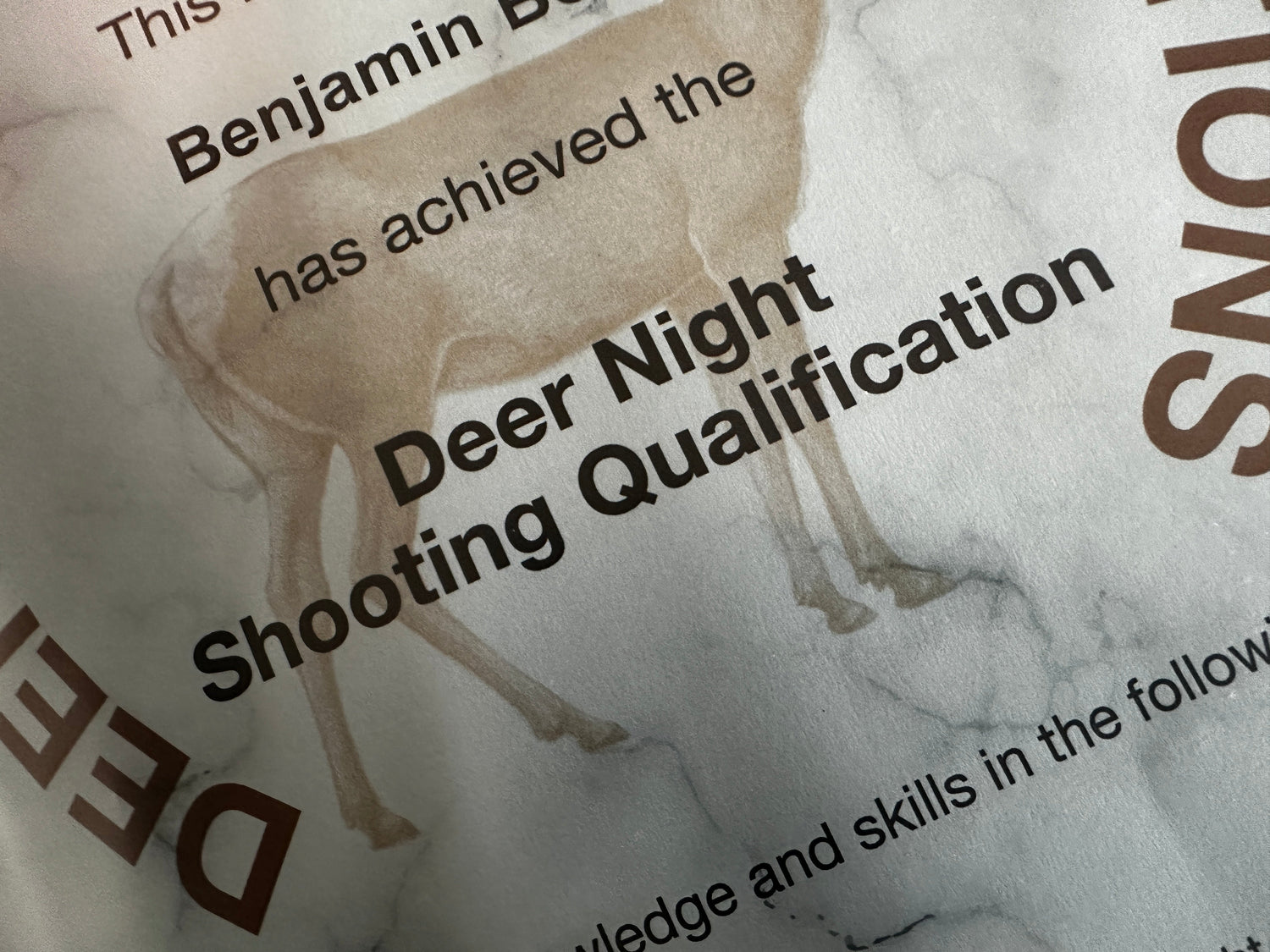
Our team hold formal deer management qualifications up to advanced level. We have City & Guilds training in animal transport. We hold deer-specific certifications, including night work under licence, alongside forestry qualifications and Open University study in environmental decision making and environmental management and organisations. We have Lantra training in live capture and immobilisation and the list goes on.
None of that exists for its own sake. We still believe that the real test lies in the work: in how you behave on difficult ground, how you manage risk around the public, how you handle pressure from clients, how you respond to a shot that does not go perfectly. Certificates do not grant you immunity from error.
What the training does do is threefold. It shows clients and regulators that we are willing to submit ourselves to the same scrutiny they expect of others. It keeps us honest by forcing us to revisit fundamentals, rather than coasting on habit. And it allows us to build more constructive relationships with bodies like Natural England, because we arrive with evidence that we understand their language and their constraints.
In simple terms, it is a signal. Not that we have finished learning, but that we have at least done the basic work and are continuing to do more.
Respecting experience without romanticising it
None of this means that experience can be taken for granted. The fact that someone has been doing the job for forty years does not automatically mean that they have been doing it well for forty years. Habits drift. Standards that were acceptable in the 1980s are not necessarily acceptable now, particularly around public safety, food hygiene or partnership working.
At the same time, it is folly to pretend that a series of short courses can compress four decades of decisions into a weekends-worth of slides. The best trainers know this. They treat older stalkers with respect, inviting them into the discussion, not treating them as relics to be brought up to speed.
A sensible approach would combine both. Recognise prior experience formally where it exists. Design advanced assessments that genuinely test high level judgement, not just basic definitions. Make it possible for someone with a lifetime of safe work behind them to demonstrate that competence without being forced to start from scratch at the same point as a novice.
That demands more effort than a simple tick-box system, but it is closer to reality.

Where certificates genuinely shift the dial
There are places where having recognised qualifications does more than keep regulators happy.
On complex Forestry Commission woodland creation schemes (WCPG or EWCO's) and CSHT CWS1 type offers, deer management is now baked into the logic of the grant. If you cannot show that you understand how to control impact, the planting and the public investment are at risk. In those settings, being able to put named, trained individuals into a management plan does change decision making. It gives confidence that reduction targets, impact surveys and monitoring are more than good intentions.
On sensitive public sites, certificates can be the difference between deer management being approved or blocked entirely. The choice is not between a qualified stalker and an unqualified one. It is between qualified work and no work. In that context, the paper may not be perfect, but it is better than another decade of unmanaged browsing.
For new entrants, structured qualifications remain one of the few realistic ways to demonstrate seriousness. You cannot accumulate thirty years of experience overnight. You can, however, commit to a pathway that shows you are willing to put time and money into learning properly. For those people, the certificates are not a burden; they are a ladder.

And where they add little
There are also places where pushing another certificate onto someone does very little for woods, deer or safety.
If an individual already holds relevant qualifications, maintains current knowledge through genuine CPD, is operating under a documented plan and has a track record of safe, effective work, forcing them through yet another near-identical course can feel like performance art. It consumes money and time that might be better spent on habitat assessment, equipment, or mentoring the next generation.
Similarly, if a landowner uses certificates as a cheap proxy for leadership, dropping the responsibility to supervise and review onto a plastic card, nothing real has been gained. Paper does not replace oversight.
The line is not always clear. That is why a neutral article like this has to end not with a hard instruction but with a question.
So, are deer management certificates worth it?
The honest answer is: it depends what you are using them for.
If they are treated as a magic shield that transforms anyone who holds them into a competent practitioner, they are dangerous. If they are used to displace and dismiss people whose only crime is to have started before formal systems existed, they are unjust. If they become an industry of their own, feeding on grants and vanity, they are a distraction.
If, on the other hand, they are used carefully - to establish a baseline, to open doors to sensitive sites, to structure genuine learning, to give new entrants a path into a demanding profession, and to support serious continuing development - they are useful. Not sufficient, but useful.
Our own view is simple enough. The deer, the woods and the public do not care what certificates you hold. They care whether you act competently at three in the morning when no one is watching. Everything else is scaffolding.
If certificates help more people reach that standard, and help those who are already there work with regulators and landowners more effectively, then they have earned their place. If they become an end in themselves, they need to be challenged.
As with most things in deer management, the tool is less important than the intent behind it.