Natural England Night licences for deer management look very straightforward on paper. There is a licence, a target species, mapped compartments and a window of time in which you are allowed to operate. You assemble a competent team, you turn up with the right kit, and in theory you simply apply your training.
In reality the work is much less tidy. Under a heavy canopy, darkness comes early and hard. Deer move in ways that do not match the neat arrows on a management plan. The view from the rifle and the view from the spotter are rarely identical. That is why, when we talk about taking our contracts seriously at Wildscape Deer Management, we come back to the same quiet principles: two sets of eyes, honest communication and technology that serves judgement rather than trying to replace it.
Darkness in the woods, a small herd and two different views
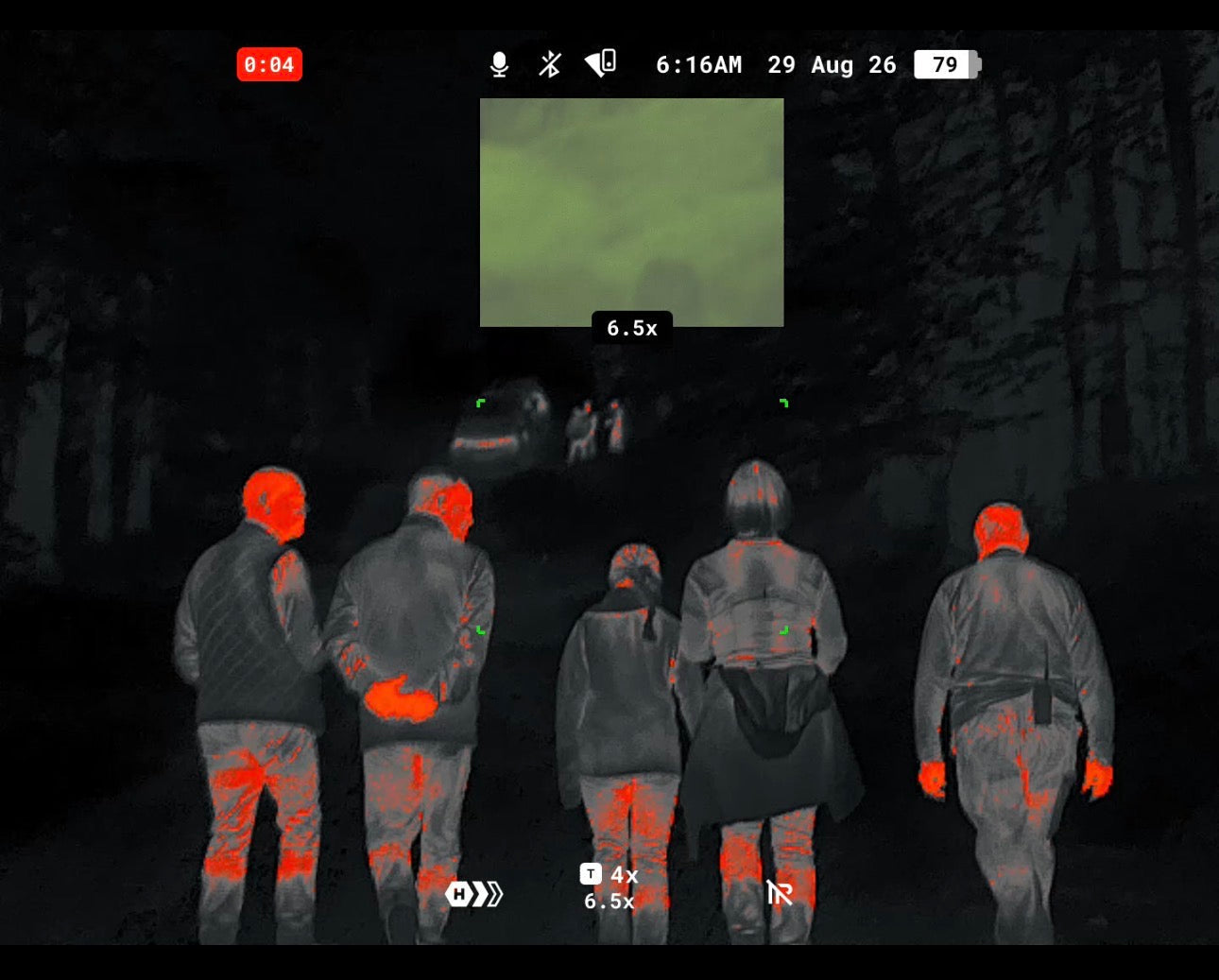
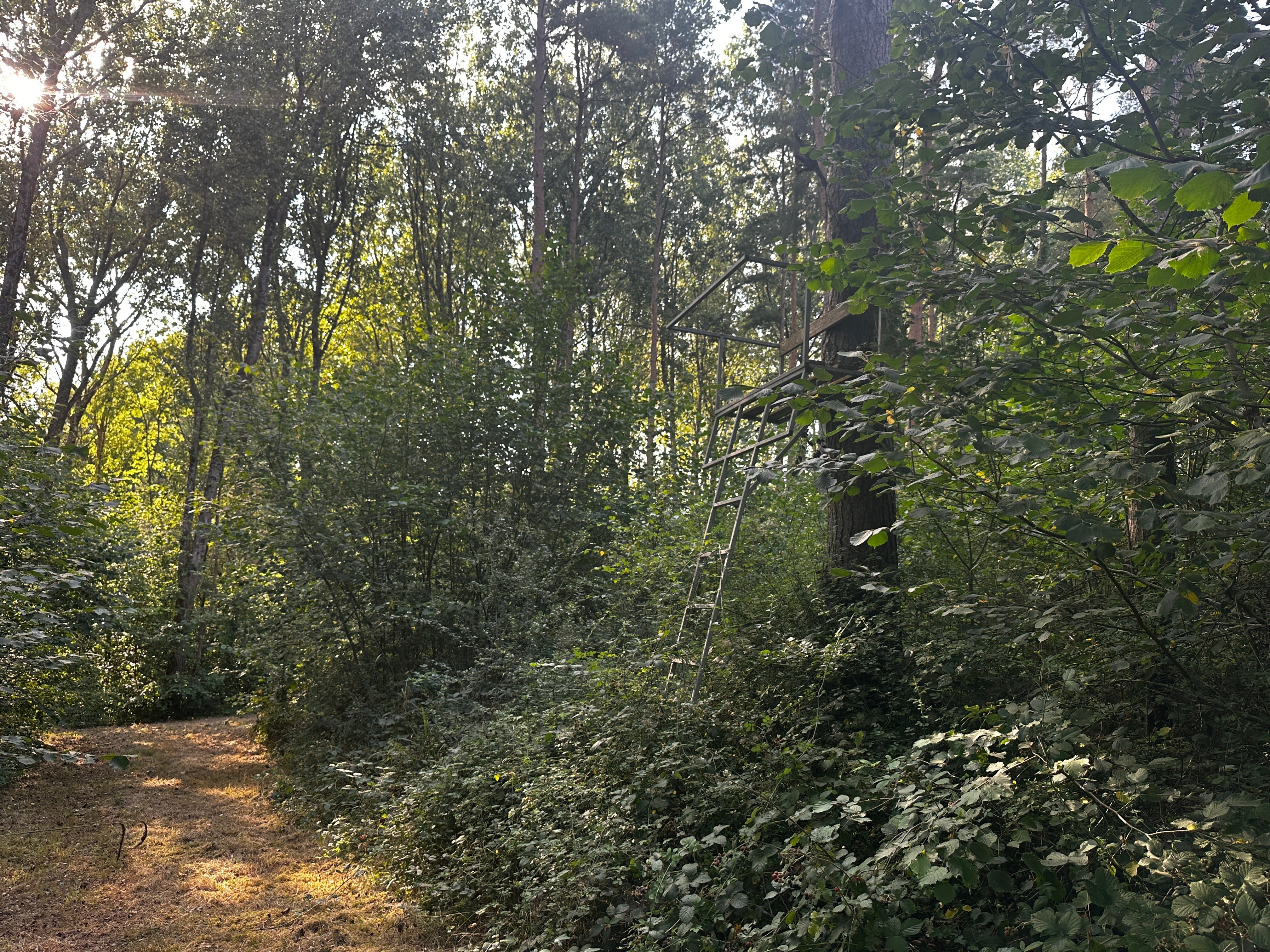
It was one of those short winter days where official last light has gone by late afternoon and, under the trees, you are effectively in night conditions (despite still being within the 1hr after sunset rule) well before most people have finished their commute. We were working a compartment of deep woodland on foot, moving slowly along an internal ride cut through a block of mature broadleaves and mixed conifers, with dense bracken tangling the ground.
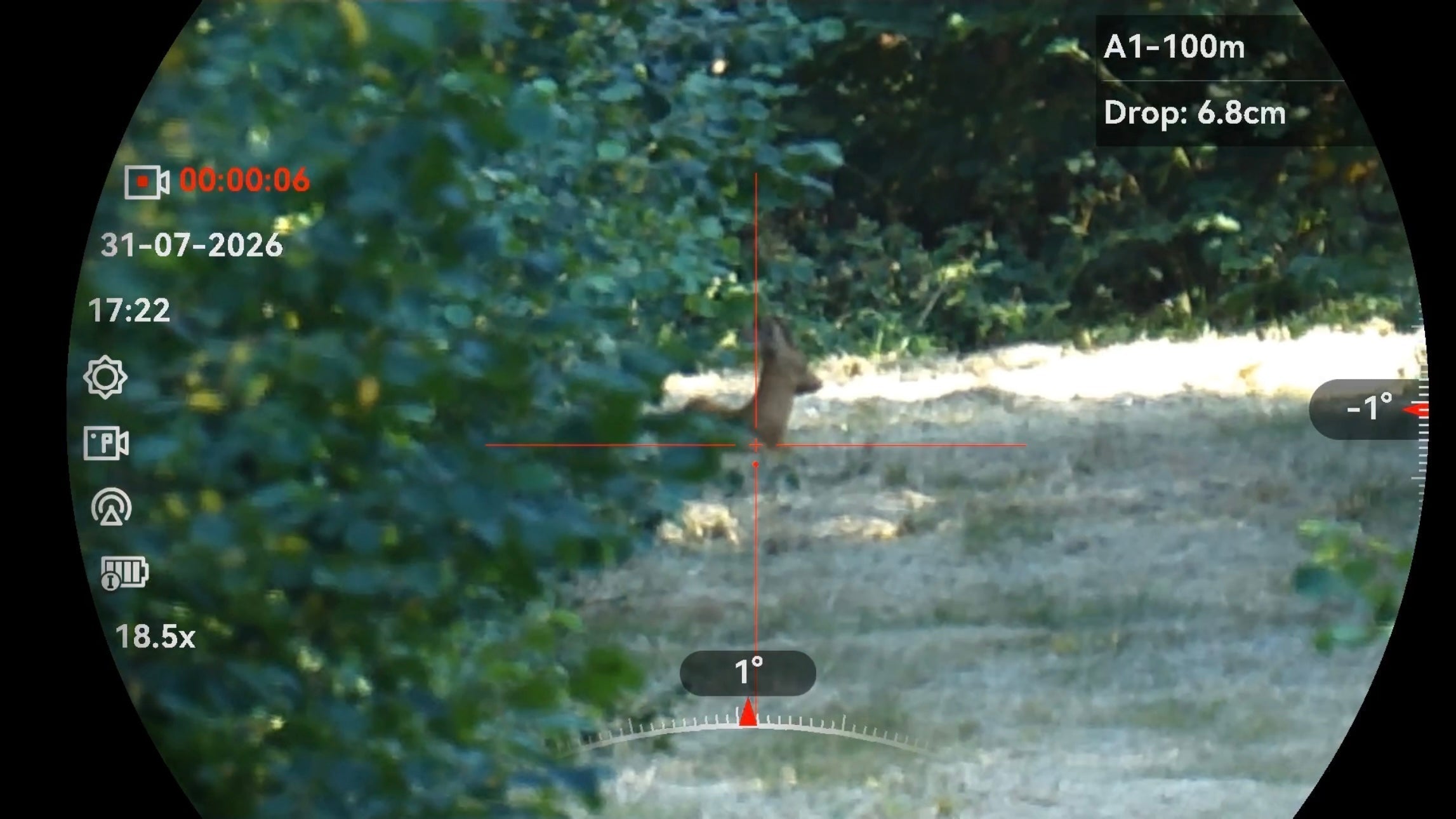
Andy was on the rifle, running a Hikmicro Alpex 4K LRF on the rifle and carrying the new Hikmicro Habrok 4K 2.0 thermal / digital binoculars. I was on our Hikmicro thermal binoculars acting as spotter. By the time we picked up the first deer, it was fully dark under the canopy. Naked-eye detail was gone. Everything we were doing depended on our technology working, experience, trust and discipline.
A small herd of fallow drifted between the trees, appearing and disappearing as they crossed gaps in the ride. Through my thermal binoculars they presented what looked like a straightforward opportunity: clear animals, broadside, with what I read as a solid backstop of trees behind. The sort of situation that tempts a spotter to say “take it” and feel their work is done.
Except Andy did not take it. He edged a step, adjusted, then waited. From my angle that hesitation made little sense. I could see the deer. I could see what I believed to be a safe line of trees behind. What I could not see, and what he could when he checked the picture through the Alpex 4K LRF and the Habrok 4K 2.0, was an awkward branch in the line of fire: large enough to cause trouble, subtle enough to vanish against the jumble of trunks and bracken from where I was standing.
From the spotter’s perspective the pause felt like delay. From the rifle’s perspective it was essential.
That was the first reminder of the evening. However experienced you are, and however clearly you think you are communicating, the rifle and the spotter are never looking at precisely the same piece of woodland. The job of the spotter is to support, not to talk the other into a picture that only exists from their own position.

Notifying the police
Before any of this happens there is a quieter piece of discipline that rarely gets mentioned. As a condition of this particular night licence we are required to inform Sussex Police about our shooting activity. It is a simple email, but it matters. The control room knows who is out, roughly where we are operating and why shots may be heard after dark. If a member of the public does ring in, the call handler already has context.
For us it is just part of the routine: ground walked, risks assessed, Sussex Police notified, only then do we start thinking about loading a rifle. Professional deer management does not happen in a vacuum. It sits inside a framework of checks that extend well beyond the trees.
The shot, the strike and the follow up
When Andy was finally satisfied that the line through the trees was clean, he took the shot. Through the Hikmicro Alpex 4K LRF the reaction looked good. From where I stood behind the thermal binoculars the deer kicked, ran a short distance and slipped off the ride into thick bracken, swallowed almost immediately by darkness.
Before thermal and digital recording, that would have been the end of the visual record. You advanced from your firing point, moved to the suspected strike area with a lamp, looked for sign and followed up based on experience and feel. Most of the time it worked. Occasionally it did not, and you were left wondering whether you had misread the reaction or the line of travel through the wood.
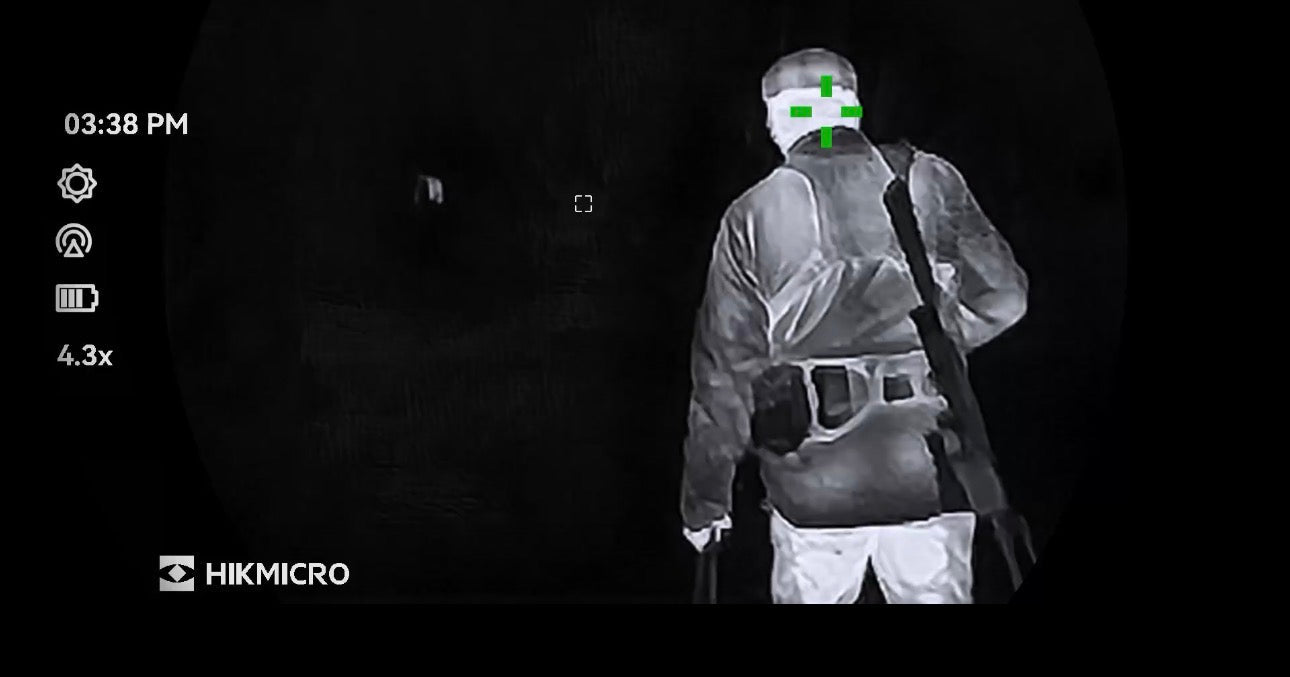
With the current generation of Hikmicro kit you have more to work with. The still image that sits with this article is taken from the recording on the Habrok 4K 2.0. In motion it shows two crucial things: the moment of impact and the direction and pace of the animal’s exit between the trees. You watch the exact instant the shot lands, see the change in posture and then track the line into the darker edge of the ride.
When we replayed the clip on the Habrok 4K 2.0, the exit channel and blood spray were visible as a faint but distinct pattern of heat as the animal broke from the ride. That told us two things. First, that the shot had done what it was supposed to do. Second, roughly where to expect the carcass in that dense bracken and tree cover.

In the event the buck was recovered less than five metres off the ride, tucked in behind fallen growth, completely invisible from our original position and utterly lost to the naked eye in the dark. What could have turned into a longer search at night under the canopy became a short, efficient follow up. The animal was out of the equation quickly, gralloched, inspected and moved. We could turn our attention back to the wider job rather than spending an hour second guessing what we had just seen.
None of this replaces traditional tracking skills. It supplements them. You still look for hair, bone, blood and disturbed bracken. You still pay attention to how animals behave when they are hit well and when they are not. The Habrok 4K 2.0 simply gives you an extra layer of evidence that follows you back to the truck and, if necessary, into the office.
Playback as a training and audit tool
Recording has a reputation as a gimmick. Something to feed social media or a toy for people who like collecting clips. Used properly, it is neither.
After a night’s work we will often run through a few sequences from the Habrok 4K 2.0. Not because we enjoy reliving shots, but because every outing contains decisions that can be examined. Did we pick the right animal from a group threading between trees. Did we miss an obstruction that only becomes obvious when you view it calmly on a screen. Did we hold our line when we should, or did the pressure of the clock and the darkness start to creep into our judgement.
Thermal playback does not flatter. It shows exactly what the device saw when the decision was made. Sometimes that is reassuring. Sometimes it is uncomfortably honest. Either way, it allows you to tighten standards, spot drift in your own habits and give apprentices and new team members real woodland examples rather than tidy diagrams.
From a contractual and regulatory point of view, having a library of footage that demonstrates how you work under licence is a quiet asset. If a landowner or regulator wants to know what “night work under strict conditions” actually looks like, you can show them: spotting with the Hikmicro thermal binoculars, waiting, declining, taking a shot only when the line through the trees is right, and following up cleanly.

The role of the kit – and its limits
It would be easy to turn this into an advert for technology. It is not. The Hikmicro Alpex 4K LRF, the Habrok 4K 2.0 and the thermal binoculars we use are tools. Very good tools, in this case, but still only tools. They are no substitute for judgement, fieldcraft or basic self-control.
The decisions that matter remain human. Andy still chose to wait until his view of the shot through the trees was acceptable, regardless of what I thought I could see from my angle. We still walked in to recover the animal on foot, reading sign in the bracken and leaf litter as generations of stalkers have always done. The electronics extended our awareness in the dark and gave us a record. They did not absolve us of responsibility.
What this combination of Hikmicro kit gave us was better information, more of the time, and a traceable record of what we did with it. In an era when night licences are under scrutiny, firearms ownership is questioned daily and estates are understandably cautious, those gains matter.

Why we talk about it
The final question is why we choose to set this out in public rather than keeping it in the notebook.
The answer is that deer management, especially under licence, relies on trust. Landowners need to trust that the people they employ are careful. Regulators need to trust that licence conditions are more than words. The wider public needs to know that the figures they glimpse between trees in the dark are working inside systems, not improvising.
By sharing how a single evening unfolded – the hesitation, the shot, the follow up in deep woodland, the thermal trace of the exit channel from the Habrok 4K 2.0, and the quiet email to Sussex Police before any of it began – we hope to make that system visible. Two people, three pieces of Hikmicro kit, one shared responsibility.
Night work is unforgiving. There is very little margin for error. That is exactly why we insist on spotters, invest in decent kit and treat every outing as though we might be asked to account for every decision afterwards. Not because we enjoy bureaucracy, but because it is the only honest way to do this work and keep doing it.