Some kit gets attention because it looks impressive. Thermal units, scopes, the latest optic everyone is discussing in the larder or on a range day. Then there is the quieter category, the equipment that rarely makes headlines but changes how you move, how you behave, and how effective you are over a long season.

For our team, the Härkila bino harness, often described by Härkila as the Deer Stalker bino strap, sits in that second category.
We have been using the Version 1 harness for a few years now across woodland deer management in the South East, and it is one of those pieces of kit that consistently gets commented on by other stalkers. Not because it is flashy, but because it looks “sorted”. It looks like the kind of system you build when you have had enough of binoculars swinging, snagging and knocking about, and you have decided that the way you carry your kit should match the seriousness of the work.

More than once I have had the same question asked in slightly different ways. What is that harness. Is it worth it. Does it get in the way. Does the magnet make noise. Does it actually keep things dry. Does it fit bigger glass. Can you run it with a thermal or rangefinder. Most people are not really asking about the harness. They are asking whether it makes you more controlled, because they can see control in the way you move.
That is the core of this review.

Why a bino harness matters in woodland deer management
Woodland deer management is not a hobby version of stalking. It is often repetitive, weather dependent, physically awkward, and carried out with an emphasis on low disturbance and high safety. In the South East you are frequently working in mixed cover with bracken, hazel, bramble, fallen limbs, wet hollows and the constant need to manage access without educating deer.
In that environment, the weakest part of many setups is not the rifle or the optics. It is the way kit hangs. A traditional neck strap turns binoculars into a pendulum. They swing forward when you step over deadfall, they tap your jacket zip, they knock against the rifle, they snag on brash and they always seem to be in the wrong place when you kneel, crawl or shoulder the rifle.
The problem is not just irritation. The problem is movement. Most deer do not notice you because you are loud. They notice you because you move when you did not need to. The harness reduces that.
The “tactical” feel is not a gimmick, it is the point
The first time you use the Härkila bino harness properly you notice something that is hard to describe unless you have worn tactical kit. The whole design feels like it has been influenced by a military chest rig. Everything is tight to the body, centred, stable, and accessible without looking down and without rummaging.
That is a compliment.
A good tactical rig is built around a simple premise: keep critical items close, keep them in the same place every time, reduce wasted movement, and allow you to operate on muscle memory. That premise transfers cleanly into deer management, especially in woodland where small movements are the thing that often ruins a final approach.
In our work, the harness is not about comfort alone. It is about creating a tidy system that lets you move cleanly and make decisions without the constant background noise of managing kit.

What Härkila actually built, and why those details matter
Härkila describe the Deer Stalker bino strap as giving you absolute control of your binoculars when out hunting, with a harness system that keeps them from dangling around your neck as you move. That wording can sound like marketing until you have spent a season watching other people’s binoculars swing and snag while yours stay pinned.
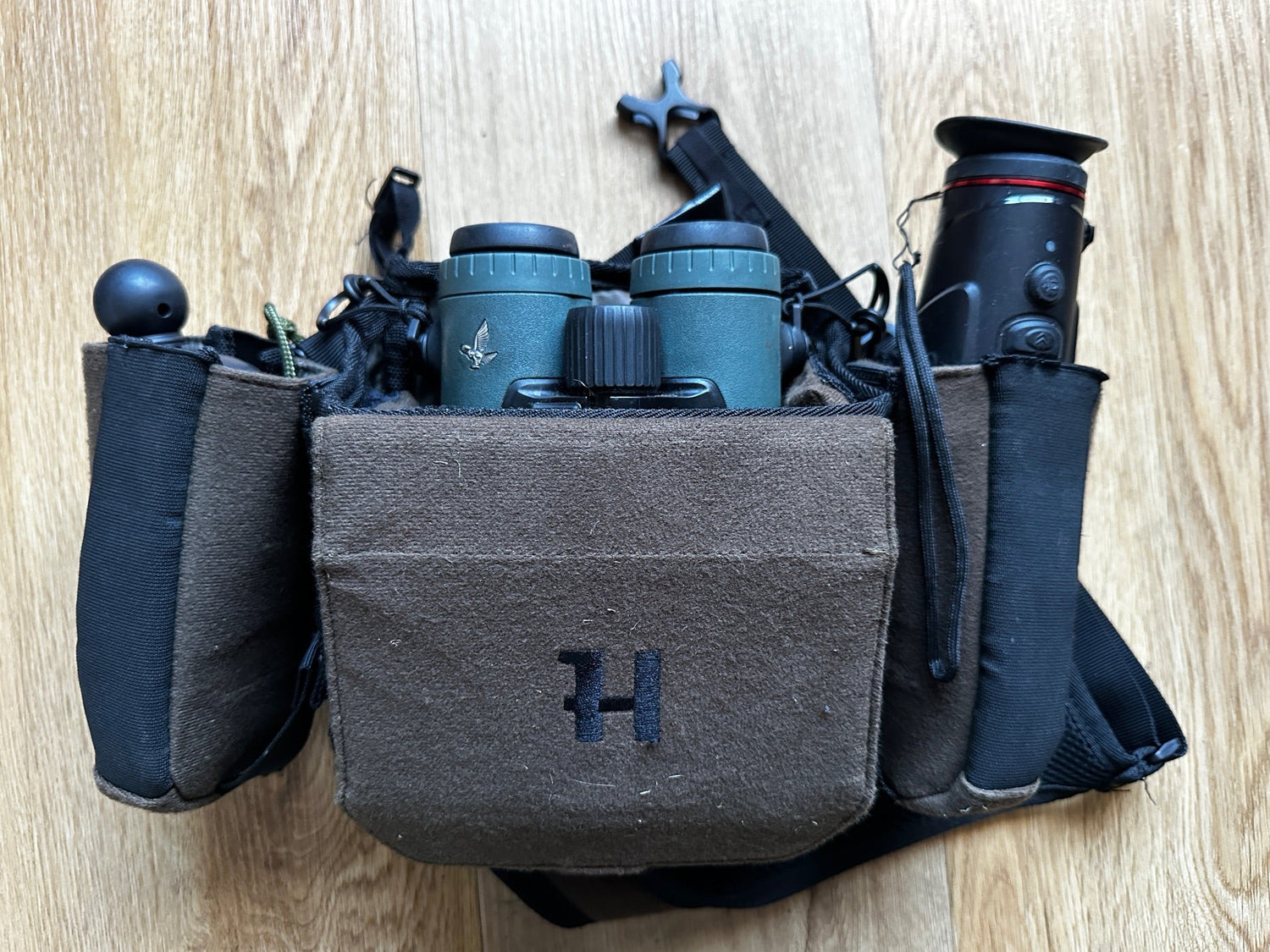
The main binocular compartment is covered by a large protective flap with a silent magnetic closure. Two things matter there. The flap protects the optics when you are not actively glassing, and the closure allows you to open and close the pouch without fumbling. In winter woodland, when gloves are wet and hands are cold, anything that reduces fiddling becomes a practical advantage.
Quiet closures matter too. Not because you are terrified of a small sound, but because repeated small sounds add up, and they often happen at the worst possible moment.
The harness can be adjusted to suit large or small binoculars. We run ours with Swarovski EL 10x42 and it accommodates them cleanly. The ability to adjust matters because harnesses that sit too low bounce, and harnesses that sit too high interfere with shouldering and head movement. The Härkila system, once set, stays where you put it.
One of the more useful details is that you can remove the binocular case itself and use the harness system alone, keeping the binoculars stable on your chest without the full pouch. Most people will never do that, but it speaks to a design philosophy that understands different user preferences. Some want full protection, others want minimal bulk. Having the choice without buying a whole new system is a sensible touch.

The MOLLE loops are the feature that turns it into a working platform
On each side and at the bottom of the bino strap, Härkila include MOLLE loops. For anyone unfamiliar, MOLLE is essentially a modular attachment system that allows you to add pouches in a secure, repeatable way.
This is where the harness shifts from “binocular holder” to “working platform”.
Version 1 comes with two stretch pockets supplied, and those pockets are not decoration. For us, those side pouches become fixed points in our routine. We keep deer calls on the right and a thermal monocular on the left. That arrangement is not random. It is repeated. It becomes muscle memory.
In woodland, muscle memory is the difference between moving smoothly and performing a noisy dance with zips and pockets. If you can reach for your call or your thermal without looking down, without rummaging, and without shifting your stance, you stay quiet and you stay focused.
Härkila even give examples of alternative uses that make sense in real life: a rangefinder holder, a wind checker bottle, or other items you use alongside binoculars. In a working deer management context, those are the things you reach for repeatedly, and keeping them stable and in the same place reduces movement.
The fabric choice is more important than people expect
Härkila state that the bino strap is made from a soft, very low-noise tricot material. That matters for a simple reason. This harness sits high on the chest, which means it is often the first part of you to touch vegetation when you push through tight cover.
Noisy fabrics announce you. Quiet fabrics disappear.
Over time you start to appreciate kit that does not scrape, crackle or shout. It is also a comfort factor. Tricot is soft against layers and does not feel abrasive. When you wear something for long sessions, especially when you are layered up, comfort becomes part of fatigue management.

The rear pocket and belt loops: the under-rated features
On the back of the harness, Härkila include a good-sized pocket suitable for a phone, a small map, or similar essentials. This is one of those features that sounds basic but becomes genuinely useful, particularly on working days where you may need quick access to mapping, location details, or a note that you do not want loose in a jacket pocket.
They also include belt loops, allowing you to detach the harness and carry the binocular case on the belt if you wish. Again, most people will not use this routinely, but it means the system can adapt. If you want to run the pouch without the full harness on some outings, you can.
It is not just versatility for the sake of it. It is evidence that the kit was designed by people who understand that field use varies.
The biggest benefit in practice: no swinging kit, no snagging, less movement
Here is the honest field reality.
In winter woodland you are stepping over deadfall, pushing through hazel, slipping along wet banks, dropping into hollows, climbing out through bracken, and sometimes crawling. A traditional strap setup makes that harder. It turns binoculars into a swinging object that knocks, catches and drags.
The Härkila harness removes that entirely. The binoculars stay close and tight. Nothing flaps. Nothing swings. Nothing is pulling at your neck. When you kneel, sit, or shoulder the rifle, you are not negotiating with your kit.
Over long outings the comfort difference becomes obvious. Neck straps concentrate weight in one place. A harness spreads it across the shoulders and back. Comfort is not indulgence. Comfort is stamina. Stamina keeps you disciplined, and discipline is what keeps deer management ethical and safe when conditions are unpleasant.
Weather protection and winter realities
The harness keeps binoculars protected under the flap when not in use, which reduces exposure to rain, bracken wetting, mud splashes and the general abrasion of woodland work.
It is not a waterproof case in the way a dry bag is a waterproof case, but it does provide meaningful protection in the conditions most of us actually work in: damp, intermittent rain, wet vegetation, condensation and mud.
The other winter benefit is reduced fumbling. Cold hands, wet gloves, darkness, and stress are a bad combination. A pouch that opens quickly and closes without noise reduces the little mistakes that lead to frustration and unnecessary movement.
 Version 2 is now available, but a practical point matters
The updated Version 2 Härkila bino harness is now available. We have not trialled it yet, so this review remains grounded in our long-term use of Version 1.
However, one detail is worth being clear about because it affects buyers. The Version 2 does not include the two side pouches as standard. They are optional extras.
That matters because for many working deer managers, the pouches are not a luxury. They are part of how the harness becomes a system. If you intend to run calls, a thermal monocular, a rangefinder, or wind checker, the cost and configuration should be considered as a complete setup, not just the base harness.
We would be keen to field test the new version and compare it properly, because Härkila tend to refine for a reason. But it is also worth saying this. Our Version 1 harness has not forced an upgrade. It continues to do the job without complaint.
Durability and why we keep using it
After hundreds of outings, across seasons, across wet woodland and heavy cover, nothing has loosened, nothing has become annoying, and nothing has forced modifications to make it workable.
That is the real test.
Good kit either becomes irritating over time or it becomes invisible. This harness has become invisible in the best way. It has stopped being an object you think about and started being part of how you move.
Is the Härkila bino harness worth it
If you stalk a few times a year on forgiving ground, you can manage without it. Plenty of people do.
If you are out regularly, especially in woodland, especially in wet conditions, and especially in situations where stealth and stability matter, a bino harness is one of the most practical upgrades you can make. It will not replace experience or judgement, but it will remove a set of small frictions that quietly degrade performance.
The simplest way to judge it is this. Does it reduce unnecessary movement, keep your optics protected, and make your working day calmer. If it does, it is doing exactly what it was designed to do.
And in our experience, the Härkila Deer Stalker bino strap does exactly that.
If you are interested in Harkila kit, you can click here which will take you to their Amazon store.