Before anything else, credit where it is due. These binoculars were sent down by Paul at Scott Country to be used on live work, not polished on a desk. There was no payment, no script and no quiet understanding that the review would be flattering. The agreement was simple: I would run the Hikmicro Habrok 4K HE25L alongside my existing Alpex 4K scope on real contracts, then say plainly what I found.
What follows is written from the position of someone who earns part of his living with a rifle, who has to justify decisions to landowners and regulators, and who has very little patience for kit that looks clever and then lets you down at three in the morning.
What The Habrok 4K HE25L Actually Is
At its core, the Habrok 4K is a set of digital binoculars that combine three things in one body:
- A thermal view for quickly finding heat sources.
- A high-resolution day and night optical view for identification and context.
- An integrated laser rangefinder for honest distance information.
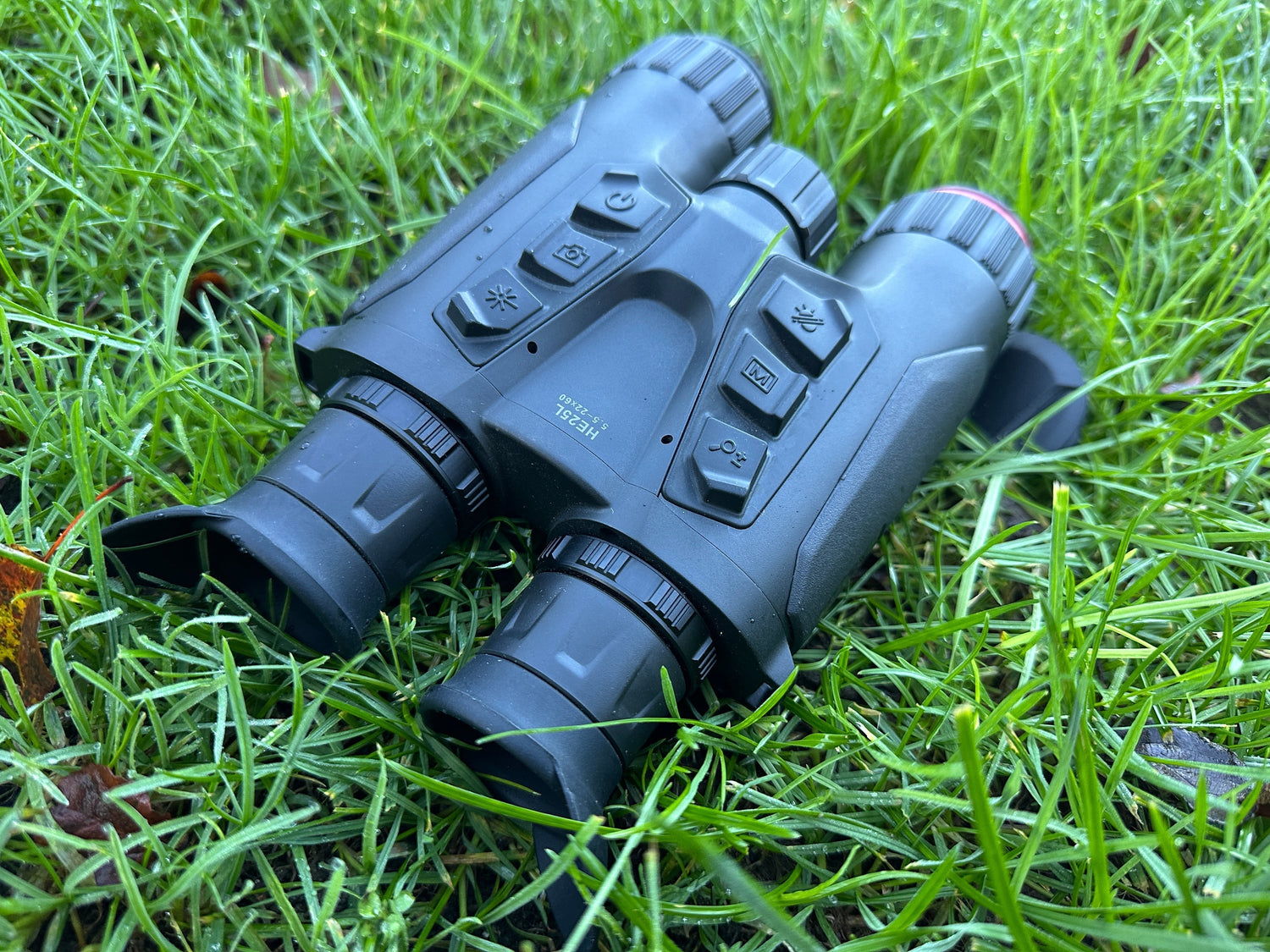
Those three elements are housed in a compact, magnesium-alloy binocular chassis. It feels like a robust mid-sized binocular rather than a science project. The weight is comfortably under a kilo, so you can wear it on your chest all night without feeling as if you have strapped a brick round your neck.
Power comes from standard 18650 rechargeable batteries. Two cells sit in the unit at a time and give you a realistically full night of work if you are sensible about screen brightness and recording. Carrying a spare pair in the pocket is easy insurance.

The important thing is not the exact numbers. It is the fact that you are carrying a tool that will:
- Find warm bodies in the dark or in cover.
- Let you see enough detail to decide what you are looking at.
- Tell you how far away it is, without reaching for another device.
That is the level at which it has to be judged.
Ergonomics And Handling
There is a common suspicion that anything with thermal inside must feel flimsy or fiddly. The Habrok does not.
Build and balance
The magnesium body gives a reassuring stiffness. There is no creak or flex when you grip the barrels hard with cold hands. The rubber armour feels like it will tolerate being shoved into a chest harness, bounced around a vehicle and used in rain without drama. In use it has been out in steady rain, frost and damp salt air and has behaved as you would expect from a unit that is built for actual field work rather than range-day showpieces.
Balance is slightly front-biased because of the lenses, but not in a way that becomes annoying. For the sort of work you ought to be doing – short, deliberate scans rather than extended stares – the weight and balance are entirely manageable.
Controls and interface
The control layout is sensible. A row of buttons sits on the top where your index fingers naturally fall. Power, rangefinding and recording can all be done without changing your grip. There is no getting around the fact that you must learn which button does what, but once that is done the muscle memory builds quickly.
Focus is split between thermal and optical channels. In practice you set each for the sort of distance band you intend to work in and then leave well alone, with only the occasional tweak when you change ground.
Eyecups adjust in the usual way and there is enough movement in the bridge to accommodate most users. In other words, it behaves like a normal binocular at the level of hands and face, which matters when you are tired.

Image Quality In The Field
The technical literature talks about sensors, resolutions and sensitivities. Those details are fine on a brochure. In the field the only real questions are: does it find things you would otherwise miss, and does it help you make better decisions.
Thermal: finding life in untidy reality
As a detector, the thermal channel is more than capable. On airport grass, arable margins, forestry rides and mixed woodland it consistently picked up foxes, deer and people in time to react calmly.
On open grassland around an airfield perimeter, foxes showed early enough that we could plan approaches without rushing. In woodland and forestry, deer bedded on banks or tucked into rides appeared clearly enough that you are not guessing whether that shape is alive.
If you abuse the system by running very high magnification in miserable conditions, the image will of course become grainy. That is true for almost every thermal device. Used in the way it is meant to be used, as a wide-area detector with moderate zoom, it does exactly what you need it to do: show you where the living things are.
Day/Night optical: identification and context
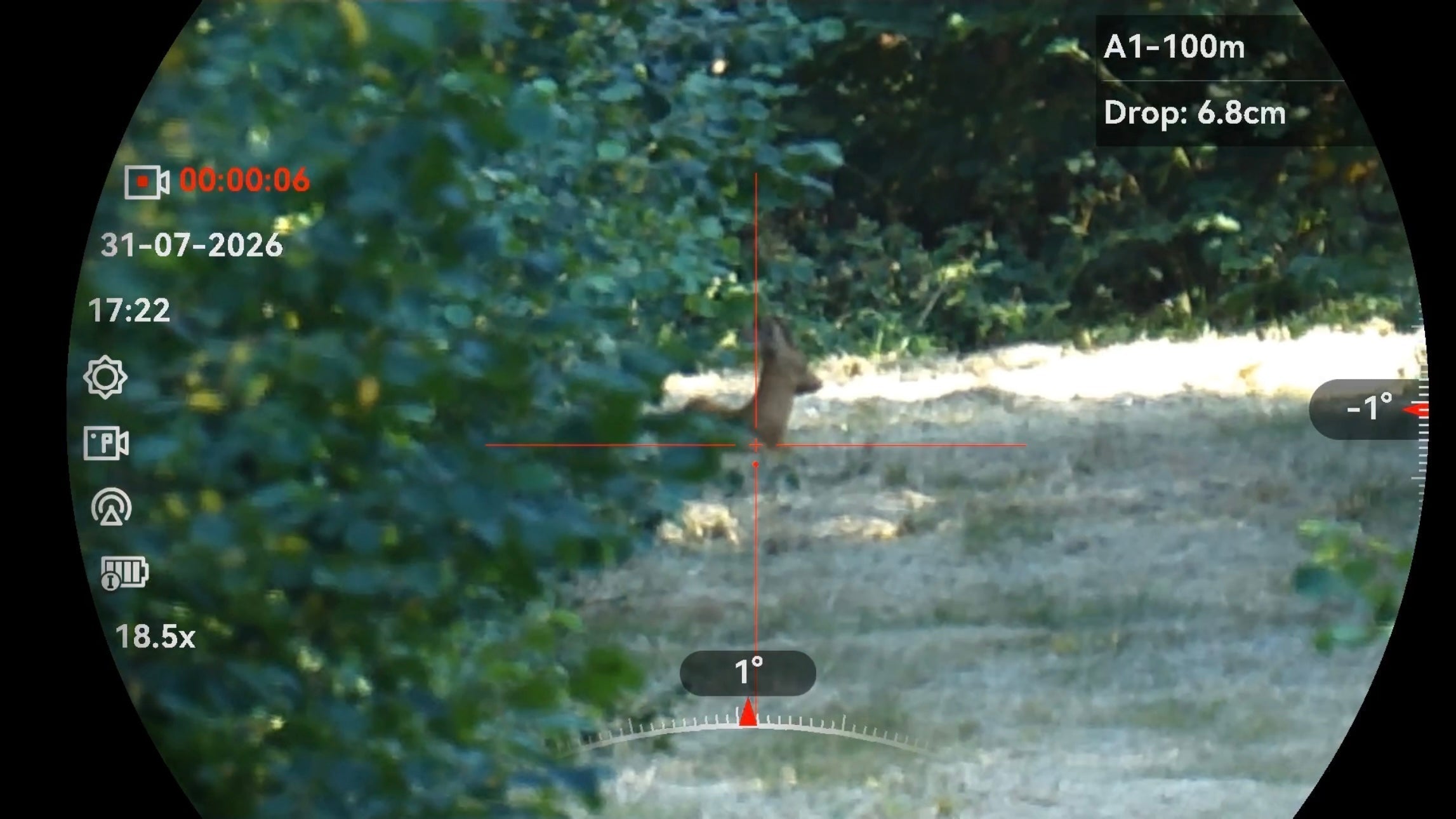
The optical channel is where the Habrok justifies the “4K” label. In daylight the image is sharp and detailed enough to read antler structure, body condition and behaviour sensibly. At first and last light, when traditional glass starts to fall away, the digital system continues to give a usable picture.
At night you can comfortably identify deer and foxes at normal shooting ranges, check what is standing behind them and make sound calls on sex and age class. You are not just seeing a silhouette. You are seeing posture, head position, whether followers are nearby and whether there are non-targets in the frame.
That is the critical step. Thermal tells you that something is there. The optical channel tells you what it is and whether you have any business pointing a rifle at it.

The Laser Rangefinder And Why It Matters
The integrated rangefinder is exactly what it sounds like: a button press in the binoculars that gives you a distance reading without moving your hands to another tool.
On simple ground that might feel like a luxury. On complex ground – airports, valley sides, large fields at night, woodland rides with little sense of scale – it quickly becomes part of your discipline.
You find a target on thermal, confirm it on the optical channel, tap the range button, and now you have a number rather than a guess. If you are running an Alpex 4K LRF on the rifle, you can then confirm that distance again on the scope. Two independent checks, both fast, both simple.
The point here is not gadgetry. It is honesty. Once you start using a rangefinder consistently, you discover just how poor unaided distance estimation can be in the dark. That forces a corrective humility and tightens up your entire approach.

Power, Recording And Connectivity
The Habrok takes standard 18650 batteries. That alone is a quiet advantage. You are not locked into proprietary packs or dependent on power banks dangling from cables. Good quality 18650s are cheap, widely available and familiar to anyone who has been using modern night vision or torches.
In realistic work, a pair of charged cells will comfortably take you through a night, especially if you make use of the automatic screen-off features when the binoculars are hanging on your chest. Carrying a spare pair removes almost all sensible anxiety about power.
Recording is straightforward. Press a button and you capture stills or video, with audio if you want it. The value of that is not social media. It is learning and evidence. Being able to review a questionable shot placement later, to revisit a herd composition, or to show a landowner a real clip of what you are seeing on their ground, is far more useful than any written description.
There is also a phone app which allows you to see what the binoculars see, transfer footage and make adjustments. That is secondary, but handy for demonstrations and for reviewing clips straight after a session.

Working With The Alpex 4K On The Rifle
Because I already run a Hikmicro Alpex 4K scope on one of the rifles, there is a natural pairing.
The menus, icons and logic are similar enough that once you have learned one, the other comes fairly easily. The rangefinder behaviour is familiar, the general feel of the reticles and displays matches, and the way the devices respond to button presses is consistent.
On a long night, that matters. Your brain does not have to switch between two completely different control philosophies. You scan with the Habrok, decide what you are dealing with, take an initial range, and then when you finally shoulder the rifle you are not re-learning another system. The transition from binocular to scope is smooth.
That does not mean you must run both to see value. It does mean that if you already use an Alpex, the Habrok will slot in without fighting you.
Use Case One: Airport Foxing
Airfield fox work is unforgiving. Mistakes can be expensive, and you are often working in a clutter of lighting, fences, vehicles and infrastructure.
With the Habrok on the chest, the rhythm changes. Most of the time you are standing back, scanning large areas of ground with thermal. Foxes show up as soon as they break cover. The optical channel then lets you check exactly what they are doing, where they are headed and what lies beyond them. You only bring the rifle into play when you have already built that picture.
The rangefinder earns its keep quickly. On an airport, the large, flat expanses play tricks on your sense of distance. A fox that feels “about 200 metres” away may be considerably more or less. Knowing the true distance tightens up both your shooting and your decision making about whether a shot is even appropriate.
Perhaps more importantly, the Habrok improves awareness of everything that is not a target: security vehicles, other teams, ground staff. You can keep track of them without constantly swinging a rifle about, which is better for safety and for everyone’s nerves.

Use Case Two: Night Licence Qualification And Assessment
Formal night shooting assessments expose your habits. You find out how often you really check a backstop, how often you almost talk yourself into a marginal shot, and how much of your supposed “process” is actually just habit.
Running the Habrok during that sort of assessment highlighted something important. The thermal image is compelling. The glowing animal draws the eye. Used lazily, the binoculars can encourage a sort of tunnel vision.
The only way to use them properly is to impose your own discipline:
- Use thermal to find potential targets and people.
- Switch to the optical image and deliberately scan the entire frame, not just the animal.
- Range only when you are sure the wider context is safe.
- Only then even think about moving to the rifle.
Once this pattern is established the Habrok helps you rather than tempts you. It becomes a structured stage in your thinking instead of a toy you chase blobs with.
Assessors notice that. They are not interested in whether your binoculars are clever. They are interested in whether you are using them in a way that reinforces judgement rather than undermines it.
Use Case Three: High Public Access Deer Work
Much of the night work in the South East now happens on ground that is heavily used by the public: country parks, estate fringes, dog walking routes, permissive paths. In those places the real question is not “can you shoot” but “can you continue to shoot here in ten years’ time without losing the public’s trust”.
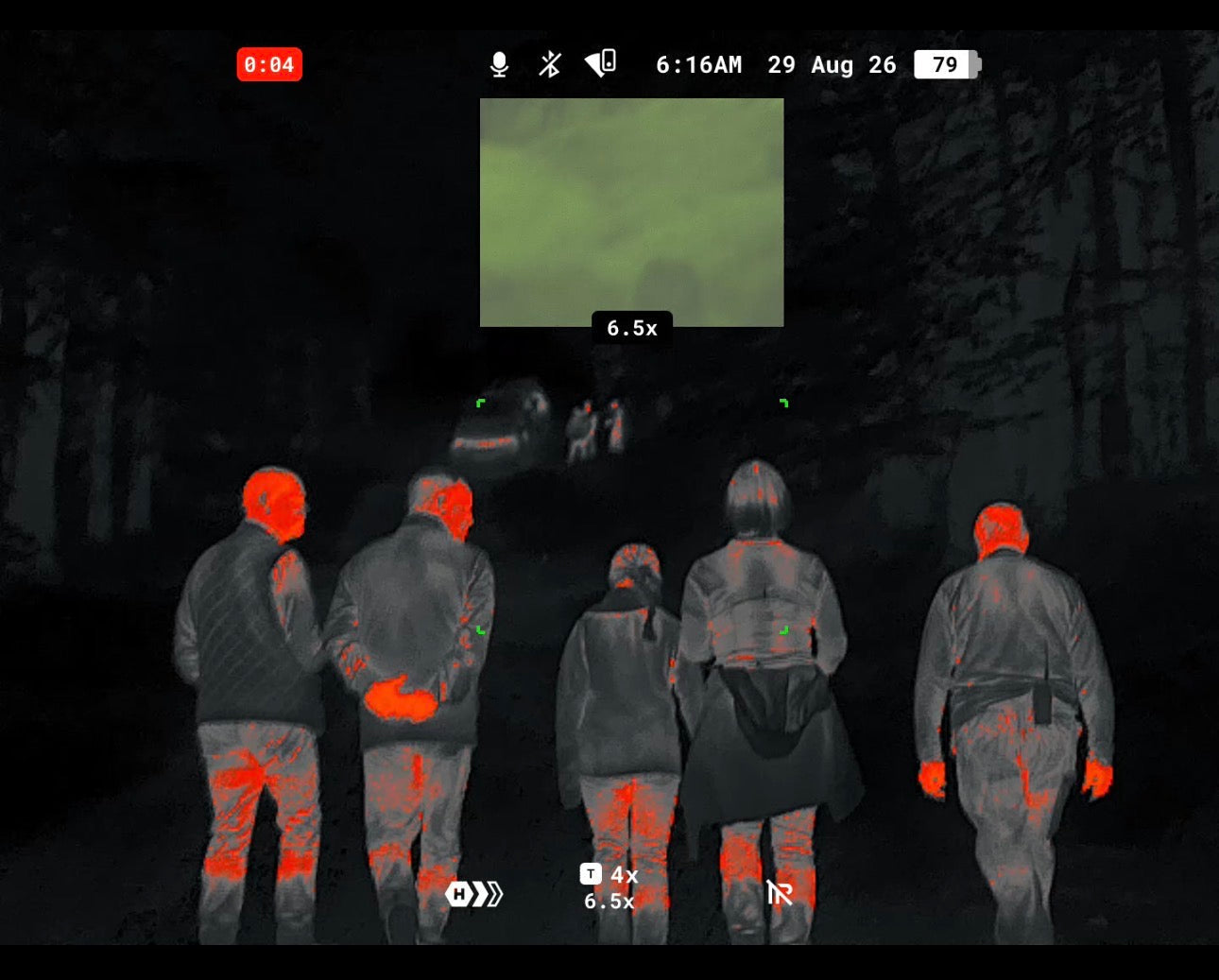
The Habrok is as much a people-finder as an animal-finder in that setting. Dog walkers, runners and late-night wanderers show clearly on the thermal long before you would pick them up with the naked eye. The optical channel then lets you interpret posture and direction. Is that a person sitting down, a walker approaching, a cyclist stopped on a track.
Armed with that information, you change how you move. Approach routes are altered to keep you away from likely public paths. Shots that might have looked acceptable through a rifle alone are discarded because the binoculars showed someone on a parallel path you would not otherwise have noticed.
Again, none of this is glamorous. It is the quiet work that allows deer control to continue near people without incidents that end up on the local news. The Habrok does not make you ethical. It reduces the excuses for not behaving ethically.

Day Work: Where They Fit And Where They Do Not
In ordinary daytime contracts the Habrok sits alongside, not instead of, good glass.
For long days glassing hill ground or open farmland in bright weather, a conventional top-end binocular remains kinder on the eyes. You are looking through pure optics, with no electronic display and no battery dependence.
Where the Habrok shines is in the margins:
- Walking into woodland before dawn or out at last light, when thermal and digital night vision can see more than bare eyes.
- Checking regeneration blocks for deer in half-light without waving a torch around.
- Combining a basic deer impact walkover with live detection, so you can see both the damage and the animals causing it.
In those circumstances the ability to flip between thermal and optical views, and to range animals without raising a rifle, is worth more than the extra few degrees of optical refinement in premium daytime glass.
The simple rule is this: if your day is built around long, bright-light observation, take the Swaros. If it is built around transitions, edges and mixed light, the Habrok earns its place.
Limitations And Honest Reservations
No tool is without weaknesses.
The Habrok is still an electronic device. Batteries must be charged and rotated. Buttons must be learned. In bitter cold with numb fingers, you can still press the wrong thing if you have not practised. None of that changes just because the unit is well made.
The thermal resolution, while perfectly adequate for detection, is not aimed at people who want to admire high-definition thermal images at extreme distances. If your main joy is zooming in on animals a long way off, on the screen, there are other devices more suited to that. Here the thermal is a workhorse: find heat, show movement, then hand over to the optical channel for detail.
Finally, and most importantly, the binoculars can create a false sense of competence if you let them. Having more information does not automatically make you wiser. It simply gives you the opportunity to behave more responsibly. If the underlying attitude to risk and ethics is wrong, the Habrok will only help you get into trouble more efficiently.

Price, Value And Who It Makes Sense For
Prices move, so it is pointless to pretend any exact figure will hold. At the time of writing, the Habrok 4K HE25L sits in what I would call the serious mid-range: more expensive than basic monocular thermals, cheaper than the very top end binoculars, and broadly in line with what you would expect to pay for a central working tool in a professional set-up.
For a casual stalker who goes out once or twice a month and does very little night work, that level of investment may not make sense. Putting money into better daytime optics, training or a more suitable rifle might do more for their outcomes.
For a professional deer manager, pest controller, airport contractor or an estate carrying regular night licences, the calculation is different. In that world the question becomes: what is the real cost of not seeing what you should have seen. One poorly judged shot near a footpath, one serious vehicle collision that could have been prevented by better understanding of deer movement, or one planting scheme quietly ruined by night-time browsing can dwarf the cost of a single piece of equipment.
Viewed that way, the Habrok is not a toy. It is a way of reducing blind spots.
Final Thoughts And Thanks
After using the Hikmicro Habrok 4K HE25L on airport foxing, night licence work with significant public access and general estate contracts, I would keep it in the toolbox by choice.
Not because it is perfect. It is not. Not because it replaces daytime glass. It does not. But because it meaningfully extends what you can know about your ground in the dark, and because it lets you do that from behind binoculars instead of always from behind a rifle.
Used properly, it helps you:
- Detect animals earlier and with fewer gaps.
- Identify what you are looking at with enough detail to act or decline.
- Understand where people, livestock and infrastructure sit in relation to any potential shot.
That combination pushes you towards the sort of cautious, reality-based practice that modern deer and fox management demands.
So a genuine thank you to Paul and the team at Scott Country for sending the unit down to be used hard rather than admired from a box. Their willingness to put equipment into real working situations, without conditions on the verdict, is part of what makes them worth dealing with.
The Habrok 4K HE25L will not make you a better shot or a better person. That part is on you. What it will do, if you allow it, is strip away some of your excuses. It will make it harder to pretend you did not know what was there, or that you did not have time to check. In our line of work, that is worth paying attention to.