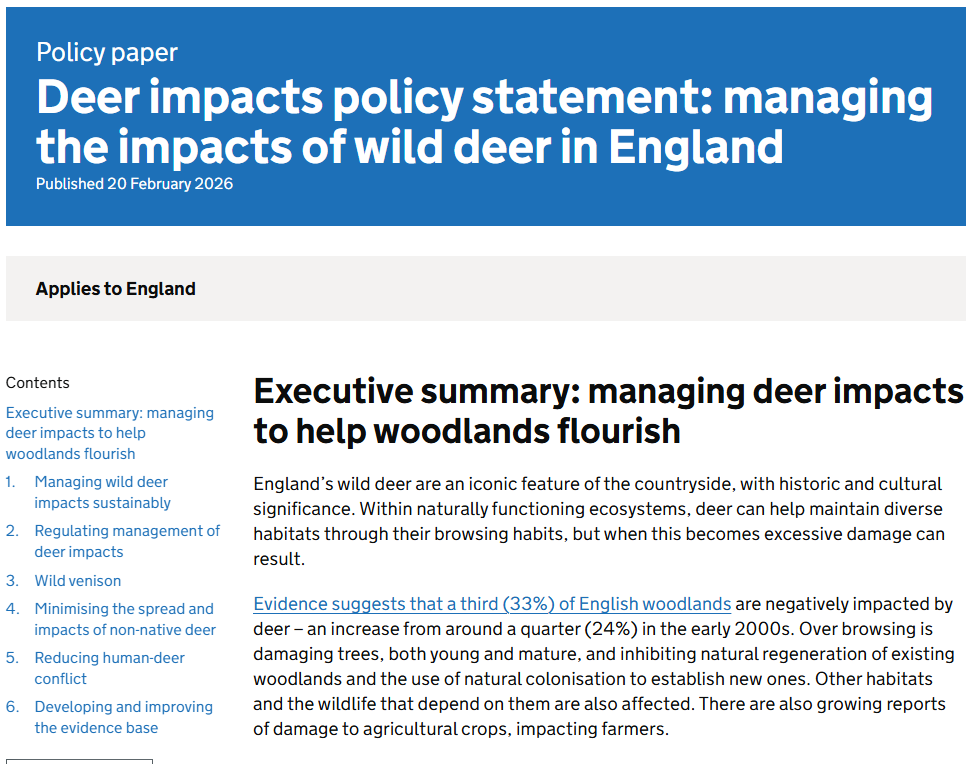
The new Deer Impacts Policy Statement, published on 20 February 2026, is one of the clearest signals we have had in years that government understands what those of us on the ground have been saying for a long time: deer impacts are now a material constraint on woodland resilience, natural regeneration, habitat condition and, increasingly, wider public interests like road safety and welfare.
It sets out a ten-year intention to shift deer impacts from something we talk about endlessly, into something we manage more consistently, with better evidence, better collaboration, and stronger expectations where public money is involved.
In plain terms, the statement acknowledges that the current approach has not prevented an increase in negative impacts, and that in many areas lethal control, delivered to best practice and within the law, is now necessary as an effective and humane tool when exclusion methods are inadequate on their own. It also ties deer management far more explicitly to the outcomes landowners are already being asked to deliver, from woodland creation and natural colonisation through to biodiversity recovery and the credibility of publicly funded schemes.
What this changes in reality, not just on paper
For most Sussex landowners the day-to-day issue is not whether deer exist, it is whether impacts are visible, persistent, and preventing the woodland from doing what it should do. The statement is unusually direct about that, including a headline figure that evidence suggests 33% of English woodlands are negatively impacted by deer, up from around 24% in the early 2000s. That is not a minor drift. It is a structural change in pressure, playing out quietly through suppressed regeneration, browse lines, repeated damage in the same compartments, and the steady normalisation of a woodland under chronic grazing.
This is the bit that catches people out on small holdings. You would be amazed how many people are adamant there “isn’t a deer issue”. That often changes the moment you walk them through the signs on the ground: suppressed regeneration, browse lines, fraying, bark stripping, and repeated pressure in the same compartments year after year. One thing we have focused on over the last year is education, not just with our contracts, but with the people we meet along the way. When you take five minutes to explain what you are looking at, the conversation becomes far more practical and far less emotional.

Our view is simple: the objective is management, not eradication. It is about balancing herd size to the landscape so woodland, hedgerows and sensitive habitats can recover, while maintaining a healthy, sustainable population. Done properly, it is measured, evidence-led and proportionate. That framing matters because the policy statement deliberately pulls deer impacts into a wider public-interest picture. It connects excessive deer pressure not only to woodland outcomes and timber values, but to deer vehicle collisions, welfare issues, crop damage, and even the wider conditions that can support higher tick burdens and Lyme disease risk.
That wider framing is not a media gimmick. It is government effectively saying: if the system is out of balance, the costs show up somewhere, and we are done pretending it is only a forestry problem.

The direction of travel: stronger expectation, not just stronger language
The most important practical signal in the statement is the shift from encouragement to expectation, especially where public funding is involved. It explicitly states an intention to ensure that where affected woodlands and features are receiving public funds, landowners undertake sufficient measures, or allow tenants to do so, where deer impacts are preventing scheme objectives being met.

Our take is that this is the quiet tightening of the screw that will actually change behaviour. For years, deer damage has been tolerated as an inconvenience and then quietly paid for through restocking, tubes, repairs, and repeated “establishment failure” that becomes normal. This statement is setting up a more direct line between evidence of impact and a requirement to act, particularly where public money is tied to woodland delivery.
The document is also explicit about why landscape-scale approaches matter. Deer do not recognise boundaries. Isolated effort is often expensive effort with limited outcome, particularly in the South East where parcels are small, disturbance is constant, and animals simply redistribute if pressure is inconsistent. The statement reinforces the role of Forestry Commission advice, including the dedicated team of Deer Officers established since 2020, and it pushes hard on coordination because it recognises the basic reality: one diligent landowner can still be undermined by inaction next door.
 Grants, kit and the uncomfortable truth about protection
Many landowners in Sussex have tried to “engineer” their way out of deer pressure with shelters, guards and fencing, then wondered why impacts simply reappear elsewhere, or why costs keep rising. The policy statement tackles that head-on. It recognises historic reliance on exclusion and protection, notes concerns around visual intrusion and environmental harm, and spells out a hard ecological truth: excluding deer from large areas can increase density and impacts outside fenced zones. It also nods to the growing interest in natural regeneration and colonisation, where shelters are often the wrong answer.
This is where the statement becomes refreshingly adult. It does not pretend that tree protection is “bad”. It simply stops treating it as the default answer for every scenario. Instead, it frames lethal control, delivered to best practice and within the law, as “the most effective and humane alternative (or addition)” when exclusion alone is inadequate or impractical, and it goes further by stating lethal control is now necessary in many areas to manage impacts.
It also confirms that grant support has been developed to reflect that direction, including the Countryside Stewardship deer control and management offer introduced in 2022, with strong uptake, plus continued availability of grants for related items such as high seats and exclosure plots.
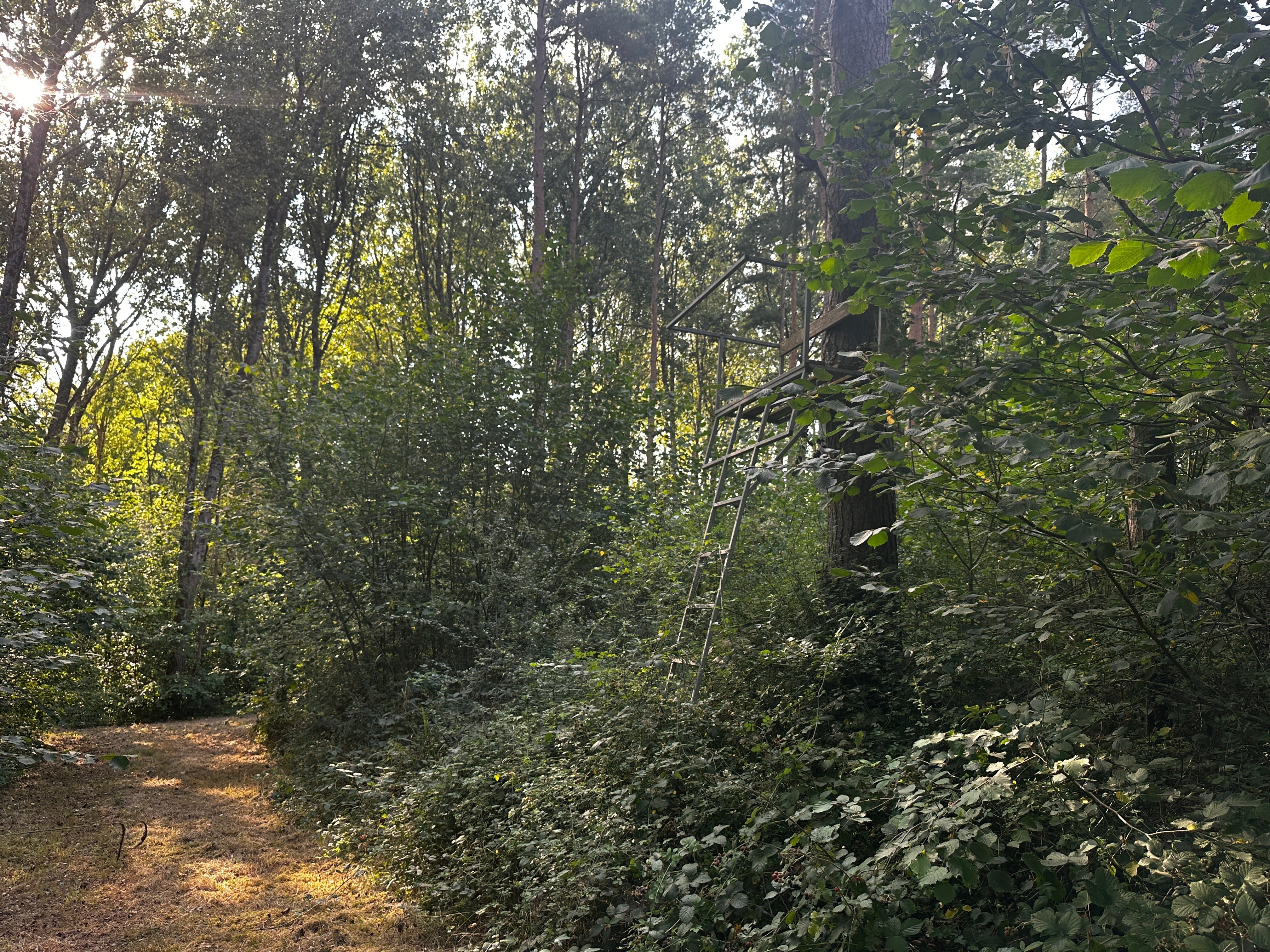
Our view is that good capital support only works when it supports a coherent plan. A high seat without a strategy is just a perch. An exclosure plot without follow-up is just a fenced anecdote. Put the kit in the right place, measure what changes, and tie effort to outcome. That is what makes the spend defensible and the work efficient.

Skills and standards: why this matters more than people admit
There is a significant undercurrent in the statement around competence and consistency. It talks plainly about the need for increased skills and capacity at practitioner and land manager level, and it goes as far as exploring whether firearms licensing guidance could be amended to encourage forces to consider requiring a minimum level of competence for those seeking to use firearms to shoot deer.
That is not an idle paragraph. It signals a future where deer management is increasingly treated as a professional discipline rather than a private pastime, especially on public-facing or publicly funded ground.
Our view is that this is unavoidable, and not necessarily a threat. The work survives scrutiny when the standards are calm, the process is repeatable, and the evidence is clear. That means safe systems, good records, clear rationale, and a willingness to walk away when margins are not there. It also means deer managers and landowners speaking the same language about outcomes, rather than arguing about feelings.
What Sussex landowners should do next
If you own or manage woodland in Sussex and you are wondering what this means for you, the first step is not to argue about deer numbers. It is to establish impact. Walk the compartments with intent, not hope. If you want a practical rule of thumb, ask yourself whether the woodland is recruiting the next generation of trees in the places it should be recruiting them. If it is not, do not assume it is “just nature”. Look for the signs that repeat year after year: suppressed regeneration, browse lines that sit unnaturally low, fraying on young stems, bark stripping where pressure has become habitual, and the same areas taking the same hits regardless of season.
If you can, set up small exclosures. They are not glamorous, but they are brutally honest. When the inside and outside diverge, the debate ends and the evidence begins.
Once you have evidence of impact, look hard at whether your current approach is actually changing outcomes. Many small holdings drift into a pattern of occasional outings that create disturbance without reducing pressure. Deer learn that rhythm quickly. In practical terms, you become a nuisance rather than a management pressure, and the result is often more evasive deer and the same habitat outcome.
If a Forestry Commission Deer Officer has flagged deer as a limiting factor on your site, treat it as early intervention, not criticism. The earlier you respond, the less expensive it is to fix. Leave it too long and you end up trying to buy your way out with shelters, replacements and repairs while the underlying pressure remains, which is exactly the cycle this policy statement is trying to break.
And if you do not have the time, inclination, or licensing framework to manage deer yourself, the realistic route is not to do nothing. It is to bring in competent support for a defined period and build a plan that is proportionate to your ground. A good deer management company should be able to help you evidence impact, map safe opportunities, agree clear objectives, and deliver control in a way that is calm, legal, welfare-led and defensible, with reporting that makes sense to you and to any scheme requirements you carry.
At Wildscape Deer Management, this is exactly where we spend most of our time: helping Sussex landowners move the conversation from “I’m not sure we have a deer problem” to “we can see the impact, we understand the objective, and we have a workable plan that fits the real-world constraints of the site”.
Our closing thought is this: the policy statement makes it harder for all of us to pretend deer impacts will resolve themselves. The work, as ever, is not in the document. It is in what happens next, on the ground.
You can read the policy here: https://www.gov.uk/government/publications/deer-impacts-policy-statement-for-england/deer-impacts-policy-statement-managing-the-impacts-of-wild-deer-in-england