Deer are easy to treat as part of the scenery. A movement in the hedge at dusk. A silhouette on a ride. A familiar presence that feels harmless until something goes wrong.
The trouble is that deer rarely cause a crisis in a single moment. The consequences build quietly, season after season, until they start showing up in the places people cannot ignore. The roadside. The garden fence. The edge of a housing estate. A call to the police about an injured animal, usually late, usually urgent, and rarely convenient.
This is why deer management is not only a woodland and biodiversity issue. It is a welfare issue.
When numbers and distribution are out of balance with what the landscape can carry, deer do not simply browse more trees. They become more exposed to risk. More conflict. More injury. And the animals pay the price first.
Collisions are not bad luck, they are pressure made visible
Most deer vehicle collisions are described as unavoidable. The driver had no warning. The deer appeared from nowhere. The impact was instant.
From the ground, it rarely feels like “nowhere”.
Collisions cluster where movement is forced. Where a woodland block has been cut off from another by a road. Where a long-established crossing point has been narrowed by fencing. Where new development has created hard edges and bright corridors that deer still need to cross because bedding and feeding are now separated by infrastructure.
Deer are not reckless. They are predictable. They move between cover and food, and they move most when light is low and disturbance is reduced. When we fragment the landscape and increase disturbance in the remaining pockets, we compress movement into fewer routes. Fewer routes means more crossings at the same points. More crossings means more collisions.
If you want to reduce deer vehicle collisions, you do not start by blaming the deer. You start by accepting what is driving their movement.
Fencing injuries are the quiet welfare problem nobody photographs
Road collisions are obvious. Fencing injuries are often not.
As land becomes more parcelled and boundaries become more engineered, deer meet more wire. Stock fences, garden fencing, temporary construction fencing, roadside mesh, loose strands left after works. A deer caught in wire rarely dies quickly. It may struggle free and drag material for days. It may tear skin, break a leg, or become trapped in a way that leads to a slow decline out of sight.
These incidents rise when deer are pressured into tighter spaces and when escape routes are channelled. Disturbance pushes deer harder through boundaries. Fragmentation gives them fewer safe lines to travel. The combination creates predictable injury.
If we claim to care about welfare, we need to care about the landscape conditions that make injuries more likely, not just what happens during control.
The urban fringe looks calm, but it is not always healthy
On the edges of towns and villages, deer can appear surprisingly settled. People see them in parks, on verges, moving through gardens, and assume that proximity to humans means they are doing well.
Often they are simply coping.
The urban fringe is a high-pressure environment: dogs, lights, traffic, fencing, people who behave unpredictably, and cover that is narrow and fragmented. Deer adapt by becoming more nocturnal, more opportunistic, and more willing to hold in awkward pockets of scrub and boundary vegetation.
That adaptation keeps them alive, but it also increases the likelihood of collisions, fence injuries, and public conflict. It changes behaviour. It increases stress. It can concentrate deer into small areas where disease and poor condition become harder to spot until they are already established.

Capacity is limited, and that is why prevention matters
The public often assume that if a deer is injured, a professional response will arrive quickly.
Sometimes that happens. Often it does not, because capacity is limited.
Trained responders and professional deer managers can only be in so many places at once. Many areas rely on a small number of people covering wide geography, on top of planned work, permissions, and safe operating conditions. Injured deer call-outs become triage. The animal’s suffering lasts longer than anyone wants, not because people do not care, but because the system is stretched.
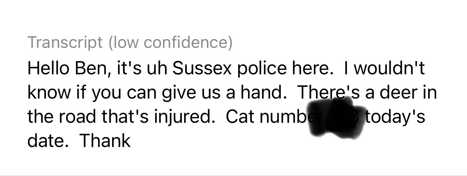
For context, I also serve as one of the Sussex Police Deer Wardens, and I am frequently called out during twilight and late at night to incidents on public highways. It gives you a sharp perspective on how quickly these situations escalate, and how often they are avoidable with better planning at landscape level.
That is one of the reasons proactive management matters. It is not simply about reducing impact on trees. It is about reducing the number of incidents that turn into avoidable suffering in the first place.
If you hit a deer at night, what to do
If you are unfortunate enough to collide with a deer, your priorities matter. In the shock of it, people often do the wrong thing for the right reasons.
Start with this:
- Your personal safety comes first. Then the safety of others on the road. Then the welfare of the deer.
- If you can, move yourself to a safe position. Put your hazard lights on. If it is safe to do so, get out of the vehicle and stand well away from traffic, ideally behind a barrier. Do not stand in the carriageway and do not put yourself at risk trying to “sort it quickly”.
- Call 999 where required, particularly if the deer is injured on the carriageway, if the incident is causing danger to other road users, if there is any risk of further collisions, or if anyone is injured.
- Be precise with your location. At night, “near the layby” is rarely helpful. Use What3Words if you have it, or give a detailed description: road number, direction of travel, nearest junction, landmark, and any identifiable features. The more accurate you are, the faster an appropriate response can be directed.
- Keep calm and do not approach the deer. An injured deer can be highly unpredictable, and even a small animal can cause serious injury. Approaching also increases risk to you from traffic and can make the situation worse for the deer.
- If you can do so safely from a distance, keep visual contact with where the animal is, and be ready to update responders if it moves off the road into cover. That information can make a real difference.
What competent deer management looks like when welfare is the aim
The word “control” makes people uneasy. It can sound hard. But unmanaged deer in a modern, fragmented, high-disturbance landscape do not produce a gentle outcome. They produce a chaotic one.
Competent deer management is not eradication. It is not emotion. It is proportionate, evidence-led work that reduces conflict and improves welfare outcomes over time.
Done properly, it is steady rather than dramatic. It reduces pressure where habitat is failing, which improves woodland structure and carrying capacity. It reduces concentration on the edges, which lowers collision risk and decreases boundary injury. It reduces repeated disturbance by planning effort intelligently, so deer are less likely to be pushed into dangerous corridors again and again.
It also supports healthier herds. Welfare issues do not always show up as starvation. They show up as chronic stress, poorer condition, higher parasite loads, and greater vulnerability in hard weather. A population can look “fine” at a glance while still being under strain.
A calm conclusion
If we ignore deer management because we dislike the idea of it, we do not remove suffering. We simply move it into places we cannot control and then act surprised when it appears as collisions, fencing injuries, and distressed animals on the urban fringe.
Deer deserve a place in our landscapes. But that place is not unlimited, and it is not automatically safe simply because the countryside looks green.
Competent deer management, carried out proportionately and with restraint, is one of the clearest ways to reduce conflict, protect habitats, and improve welfare outcomes at the same time. In the South East, that increasingly means judging success not only by what recovers in the woods, but by what stops happening on the roads.