There is a version of deer management that lives in people’s heads where the work is essentially over once the shot is taken. The animal is down, the job is done, and the rest is just carrying.
Anyone who has done a wet British winter properly knows that is fantasy.
The real work often begins after the shot, particularly in the South East when we get weeks of heavy rain, standing water in rides, saturated soils and ground that looks firm until the moment a tyre breaks the crust and sinks. In those conditions, extraction is not a practical inconvenience. It becomes a defining part of the decision-making, and a defining part of whether standards stay high or quietly slip.
This winter has been one of those reminders. We have had a quad stuck, and we have had an Isuzu truck close enough to stranded that it forced a rethink. That is not said for drama. It is said because it happens more than people admit, and because it should shape how we operate long before anything is taken.
The shot is not the finish line, it is the beginning of responsibility
A clean shot is only half the welfare equation. The other half is recovery. How quickly you can get to the carcass, how you handle it, and how you protect it from contamination and damage on the way out. In wet conditions, those parts become harder, slower and more physically demanding. That is where poor habits creep in.
If you have ever tried to drag a deer through dense bracken, over deadfall and across saturated ground, you know what happens. The carcass picks up water, leaf litter, mud, grit, faecal contamination from the ground, and in the worst cases it takes knocks that make gralloching and handling messier than it needs to be. Hygiene becomes more difficult to control, and the effort required climbs fast.
This is one reason we plan extraction before we plan the shot. Not as an afterthought, but as part of deciding whether an animal is actually recoverable to the standard we demand.
On a good evening, you can take a deer, recover cleanly, and be back at the vehicle with minimal disturbance and minimal fuss. In a wet winter, the same action can become a long, physical job where the margins tighten and the chance of error rises. A professional approach is recognising that difference and adjusting accordingly.

Wet ground changes everything, including the choices you think are available
Saturated woodland does not just slow you down. It alters the entire operational picture.
A ride that is normally a clean access line becomes a shallow ditch. Low spots become traps. The edges of tracks soften and crumble. If you push a vehicle into the wrong place, you can create ruts that last for seasons, harm the woodland structure, and annoy everyone who has to use the track after you.
There is also the less obvious problem. Wet ground is noisy and quiet at the same time. You can move silently across soft moss and then suddenly splash through standing water that cannot be avoided. You can leave scent and disturbance in places where deer will notice it immediately. You can end up funnelling yourself into the same access route every time because the alternatives are no longer passable. That repeated pattern is exactly how deer learn you.
So the “wet winter extraction” problem is not only about dragging weight. It affects how you approach, where you can safely position, and whether your presence becomes predictable.

Why we keep coming back to the trolley
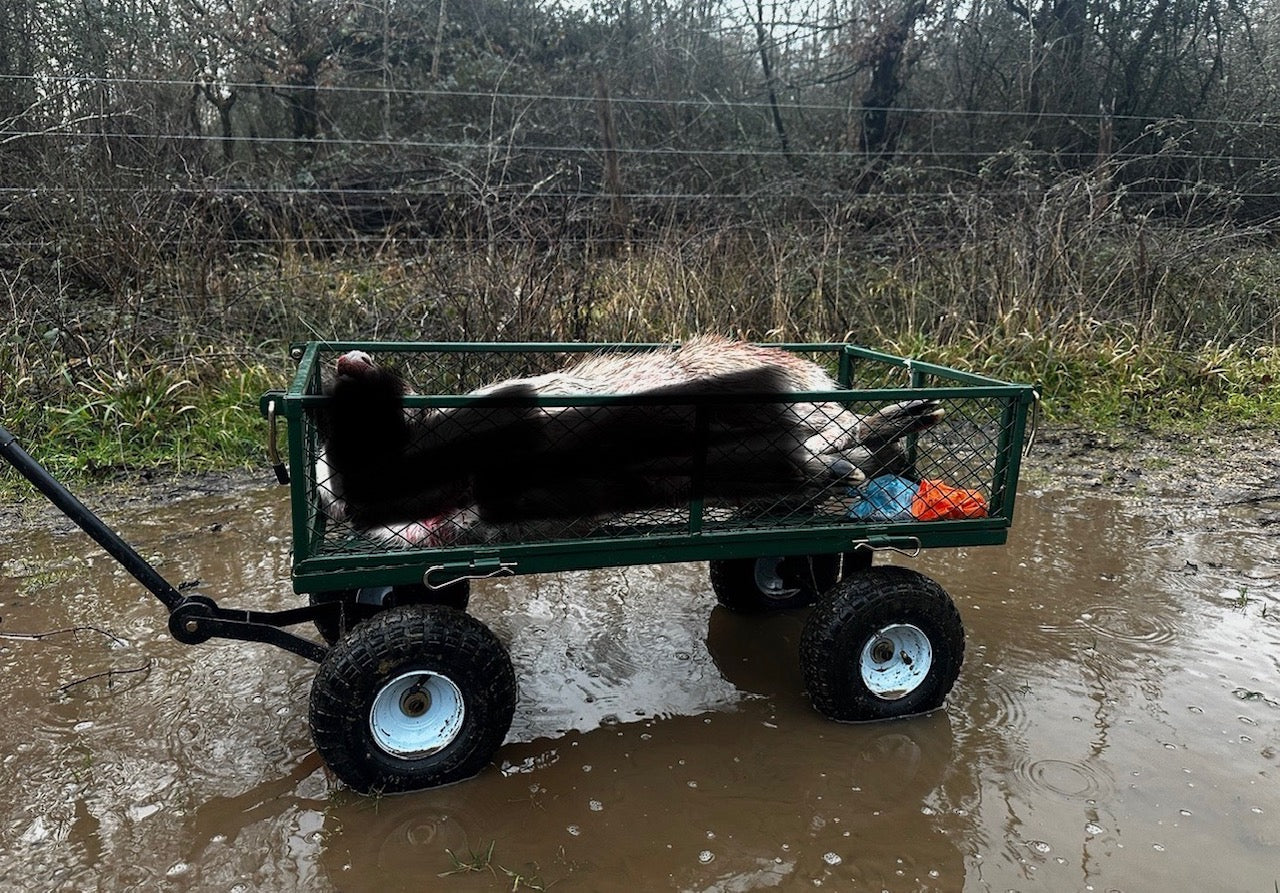
We have a favourite extraction trolley for a reason. It is not glamorous kit. It is not something people film for social media. It is, however, one of the most useful pieces of equipment we own for maintaining standards in difficult conditions.
A trolley does something simple. It keeps the carcass off the ground.
That single detail is the difference between clean and compromised. It reduces contamination, reduces waterlogging, reduces the amount of leaf litter and grit that ends up where you do not want it, and makes handling in the larder cleaner afterwards. It also reduces the physical strain on the person doing the work. Dragging repeatedly is a fast route to a damaged back, and a damaged back is a fast route to shortcuts.
In wet conditions, it also helps you move more intelligently. Instead of committing to a vehicle track and hoping it holds, you can often extract by foot along a safer line, avoiding the low spots that swallow tyres. You sacrifice speed for control, which in professional terms is usually a sensible trade.
This is particularly relevant for small woodland owners and part-time stalkers. If you only go out occasionally, it is easy to underestimate extraction and overestimate what you can “just manage” by dragging. In a wet winter, the ground will punish that optimism. A trolley is not just convenience. It is a way of keeping the job within safe limits.
Vehicles, ego, and the false economy of forcing access
One of the quiet dangers in field work is ego. Not the loud version, but the subtle version that says, “We can get through. We always do.”
Wet winters punish that mindset. Once a vehicle is committed, you often have two problems instead of one: a carcass to extract and a recovery operation for your own kit. That is wasted time, increased risk, increased disturbance and usually a good dose of frustration. None of which improves welfare, and none of which improves professionalism.
We have been close enough to that line this winter to treat it as a reminder. It is not worth it. If the ground is telling you no, listen. The cost of recovering a stuck vehicle, even if you succeed, is rarely worth the strain and the damage.
A quad has its place. A pickup has its place. But neither is a magic solution when standing water and saturated soils take over. Sometimes the correct answer is to accept slower extraction and use the trolley, or to limit the work to areas where recovery is clean and realistic.
Health and safety is not paperwork, it is how the job stays sustainable
Extraction is where injuries happen. Slips, strains, twisted knees in bracken, fingers trapped in awkward grips, exhaustion, and poor lifting when people are cold and rushing. If you are working alone, the risk rises again, because there is no immediate support if something goes wrong.
A professional approach in winter means being honest about that risk. It means thinking about lighting, footing, distance, gradient and fatigue. It means planning a route out that you can still manage when you are carrying weight, not the route that feels easiest going in.
It also means being honest about when to stop. There is a point where pushing harder does not make you more committed. It makes you more likely to make a mistake that costs you far more than the evening was worth.
The decision to shoot is also a decision to recover
This is the part that separates tidy stalking from professional deer management. The decision to take an animal is also a decision to recover it properly, handle it properly, and leave the site in a state that does not create avoidable damage or complaint.
In wet winter conditions, that decision must be stricter. Not because we become less effective, but because the consequences of getting it wrong are larger.
That is why some evenings end with nothing in the chiller. Not because deer are absent, but because the extraction picture is not clean, the backstop is not right, the access is compromised, or recovery would force standards below what we are willing to accept. Walking away is sometimes the most professional act you can do.
Carcass condition is not negotiable
If you care about venison value, the wet winter problem matters. A carcass dragged through mud and water, picked up and dropped, contaminated with grit and debris, is not the same product as a carcass recovered cleanly. It takes more work in the larder, it carries more risk, and it reflects poorly on the whole operation.
Even if you are not selling venison, carcass condition still matters. It is part of welfare respect. It is part of hygiene. It is part of how you maintain self-respect in the work.
The trolley helps. So does good planning. So does restraint. It all comes back to the same principle: extraction is not a footnote.

A practical closing thought for small landowners
If you manage a small block and you are convinced you “don’t have a deer problem”, the wet winter often reveals the truth faster than any argument. Browsing pressure shows up in suppressed regeneration, bark damage, and a woodland that looks tidy but has no future structure. When you do decide to act, it is tempting to focus on the shot and ignore the logistics.
Do not.
On small ground, extraction can be the deciding factor in whether you can manage deer safely and consistently. If you are working after work, in the dark, in the wet, with limited access, your margin is small. The right kit and a realistic plan make the difference.
A trolley, good lighting, a planned route, and the discipline to only shoot what you can recover cleanly will keep your standards intact.
The hard truth, said plainly
A wet winter does not forgive sloppy extraction. It magnifies every weakness in the system.
If you want deer work to stay safe, ethical and defensible, treat extraction as part of the job, not as something you improvise once the deer is down. Plan it. Equip for it. Keep the carcass clean. Protect your own health and safety. Accept that sometimes the right answer is to walk away and come back when the ground gives you a better chance of doing it properly.
That is not softness. That is professionalism.