There is a particular kind of frustration that creeps into deer management as the years stack up. You have two decades on the ground. You have learned the hard lessons in real weather, with real consequences, and you have built a method that keeps you safe, calm, and consistent. Then, suddenly, the wider world begins asking for proof, not in the form of outcomes, but in the form of certificates.
That tension sits at the heart of the DSC Level 2 question.
I have been stalking for around twenty years. I completed DSC Level 1 back in 2012, and since then I have added other training and qualifications as the work demanded it, including advanced deer management and night work. I have gralloched, processed and handled more deer than I care to count. I am registered as a food business. In other words, I did not feel a deep personal need to chase DSC Level 2 as a gateway into competence. Competence, at least in the field, is something you build through repetition, mentorship, restraint, and a willingness to be honest when the right decision is to walk away.
So why did I sign up?
Because the opportunity came up through the night licence contract work connected to the South Downs pilot scheme, and at that point I had very little to lose. If the sector is moving toward a place where structured evidence matters more, then the sensible response is not to complain about it from the sidelines. The sensible response is to understand it properly, test it against your own standards, and then speak honestly about where it helps and where it risks becoming theatre.
This article is written for anyone standing at the same fork in the road. People working their way through the system.
People coming in from another career who need a credible pathway. Experienced stalkers who feel mildly insulted by the idea that a certificate might suddenly define them. And landowners and agents trying to decide what “good” looks like when they are commissioning deer control under scrutiny.
The wider argument: training as professionalism, or training for the sake of training
There are now more routes into deer-related qualifications than there were when many of us started. That is a good thing in principle. More training providers, more formats, more flexibility, more chance for good people to enter the sector with structure rather than guesswork. It also creates a new kind of noise: comparisons, rivalry, and the inevitable “which one is best”.
The truth is that “best” depends on what problem you are trying to solve.
If you are a recreational stalker who wants to progress safely, build confidence, and understand the full chain from shot to food, a structured qualification can be a very sensible investment. If you are looking for access to syndicates, estates, Forestry England permissions, or partnerships where due diligence is tightening, then the qualification becomes less about personal development and more about legibility. It is a way of showing, quickly, that you have met a recognised standard.
But here is the uncomfortable part the sector does not always say out loud. I have seen highly qualified deer managers on paper who had very limited experience on the ground. People who have spent thousands of pounds in a short period collecting certificates, then found themselves out of their depth when conditions were not tidy. That is not a moral failure. Some of those people are doing their best and I respect anyone who can pursue high standards alongside another career. Not everyone has the privilege of being out constantly. But it does highlight a reality: certificates can demonstrate knowledge and process, but they cannot automatically install judgement.
Judgement still has to be earned.
And that is why I remain neutral, but not naive, about how qualifications should be treated. They are not the destination. They are scaffolding. Useful, sometimes necessary, occasionally over-emphasised. The best ones encourage humility rather than ego.

What happened when I signed up
Once I registered, the first step was access to the online portfolio system. Shortly after that I had contact from my primary assessor, Steve Matthews. I will say plainly, because it matters: Steve is an asset to the industry. The tone was formal enough to be professional, but relaxed enough to make it workable. No performance, no power play, just a straightforward approach that keeps standards clear while recognising that candidates come with different backgrounds.
I was asked for a breakdown of experience, which I put together as a CV and uploaded, along with the completion of the profile information. I was then invited to report back once I had arranged the witness stalk, which I had already lined up with the Cowdray Estate.
This is a key point for anyone considering it. The system, done properly, is not trying to catch you out. It is trying to see whether you can demonstrate a complete and defensible chain of practice. That is a different emphasis to the way many people talk about stalking, where the shot becomes the whole story. DSC Level 2 is pushing you to show the professionalism around the shot.

The witness stalk and the four elements
The witness stalk has defined components you must demonstrate. Put simply, you are being assessed on the process, not just the outcome. The four elements are clearly set out by DMQ and the scheme documentation, and they cover:
- Stalking the deer, taking it safely and lawfully within the context of the day
- Carcase handling and hygiene from the moment the animal is down
- Preparation and inspection, with the right awareness of health, contamination risks and reportable concerns
- Transport and installation of the carcase in a way that is safe, clean and compliant
That is a useful framing, because it reflects the reality of professional deer work. Anyone can talk about marksmanship. Not everyone can talk clearly about follow-up discipline, inspection, hygiene, record-keeping, and the small decisions that separate a tidy operation from a sloppy one.

I am not going to break down the witness stalk itself in detail. That is not the point of this article. What I will say is that it was a reminder of something the public rarely understand and even some stalkers forget when they are trying to look competent online. The work contains long periods of waiting, losing sight, regaining position, losing it again, and constantly choosing patience over pressure. We tracked a particular muntjac buck over several hours, with repeated moments where the animal simply slipped away into cover. That is normal. Anyone who tells you otherwise is either very lucky or very selective about what they share.
The narrative: where the value really sits
After the stalk, you are invited to complete a candidate narrative. This is where I went over and above. Not because anyone demanded it, but because I wanted the process to be honest, complete, and useful as a record. I broke down the entire sequence: preparation the night before, kit checks, cleaning and readiness, the practical realities of arrival and confirming suitability, first aid considerations, and then the stalk itself in clear stages.
I included actions before the shot, observations, approach, shot placement reasoning, reaction, follow-up, inspection, recovery, and then the larder objectives. I also recorded what I looked for from a health perspective, and how I would frame any concerns. I went into enough detail that the document ended up close to four pages.
Steve commented positively on that level of detail.
And this is the part that surprised me slightly. Writing it down, properly, forces clarity. You can be very competent in practice and still realise, on paper, that there are areas you have been doing by instinct rather than by consciously articulated method. When you take the time to put it into words, you either expose a gap or confirm that your process is genuinely sound.
There is value in that, even for someone who has been doing it for years.
It becomes a kind of professional mirror.
The assessor call: formal, calm, and quietly thorough
After the narrative, Steve and I arranged a call that lasted around forty minutes. He asked about what happened on the day, but he also asked wider questions that explored areas not fully covered in my write-up. Again, the tone mattered. It was formal enough to maintain integrity, but not adversarial. It felt like a professional discussion, not an interrogation.
Following that call, Steve completed his assessment and contacted my approved witness. From what I understand, there is an additional quality assurance layer beyond the primary assessor, which is appropriate given the stakes of the qualification.

So was it worth it?
Here is the honest answer.
If I could go back and make the decision again, earlier in my career, I am still not completely sure I would rush to do it. That is not a criticism of the qualification. It is simply the reality that, for someone already operating at a professional level with established access, established systems, and long experience, DSC Level 2 may not dramatically change your day-to-day practice.
But that is not the only measure.
For people working their way through the system, yes, it is worthwhile. For those seeking access to more ground, syndicates, estates, Forestry England arrangements, and any setting where due diligence is tightening, yes, it is often a practical gateway. For anyone who needs to demonstrate competence in a way that is legible to people outside our world, yes, it carries weight.
And for those of us who have been doing it for years, I think it still adds something. Not because it suddenly makes you competent, but because it adds credibility in the language that clients, agents and organisations increasingly understand. It also reinforces the discipline of evidence. You can say you operate cleanly. Or you can document it. The second option protects you, protects the landowner, and protects the wider reputation of the work.
The reduction from three stalks to one makes it more accessible and more affordable than it used to be, and that is a genuine improvement for candidates weighing cost against return. The paperwork, surprisingly, can be a good exercise rather than a chore. It makes you articulate what you actually do and why, right down to the details most people only half remember until they are asked. It is one thing to know your anatomy and inspection points in practice. It is another to set it out clearly on paper and realise where you might tighten your method.
Does it prove competence?
It proves something.
It proves you can operate through a complete process under observation, record it properly, speak about it coherently, and align your actions to a recognised standard. That matters.
But it does not prove you have judgement born of a thousand nights in poor weather, dealing with public pressure, unpredictable wind, awkward access, and the quiet reality that not every outing produces a result.
That is why the best approach is balance.
If you are early in the journey, qualifications are not a shortcut, but they are a strong framework. If you are experienced, qualifications are not an insult, but they can feel like one if they are treated as the only measure of competence. The mature position is to recognise what each thing is for. Experience builds judgement. Training builds structure and common language. A good deer manager needs both, even if the ratio differs depending on the person.

My conclusion, as someone who did not “need” it
Completing DSC Level 2 has not changed how we operate at Wildscape. Our standards were already built around safety, hygiene, welfare, record keeping, and defensible decision-making. But I am still pleased I did it.
It gave me a structured opportunity to document a method I have lived for years. It reinforced that the quiet disciplines of preparation, inspection and reporting are not optional extras. They are part of what makes this work respectable. It also gives something useful when operating within publicly sensitive frameworks where scrutiny is part of the environment, not an occasional annoyance.
If you are considering DSC Level 2, ask yourself a simple question. Are you looking for a badge, or are you looking for a framework that helps you be more consistent and more defensible?
If it is the second, it is far easier to justify. And if you are already competent, you may find the same thing I did. The qualification might not change your hands, but it can sharpen your language. In the current landscape, that is not nothing.
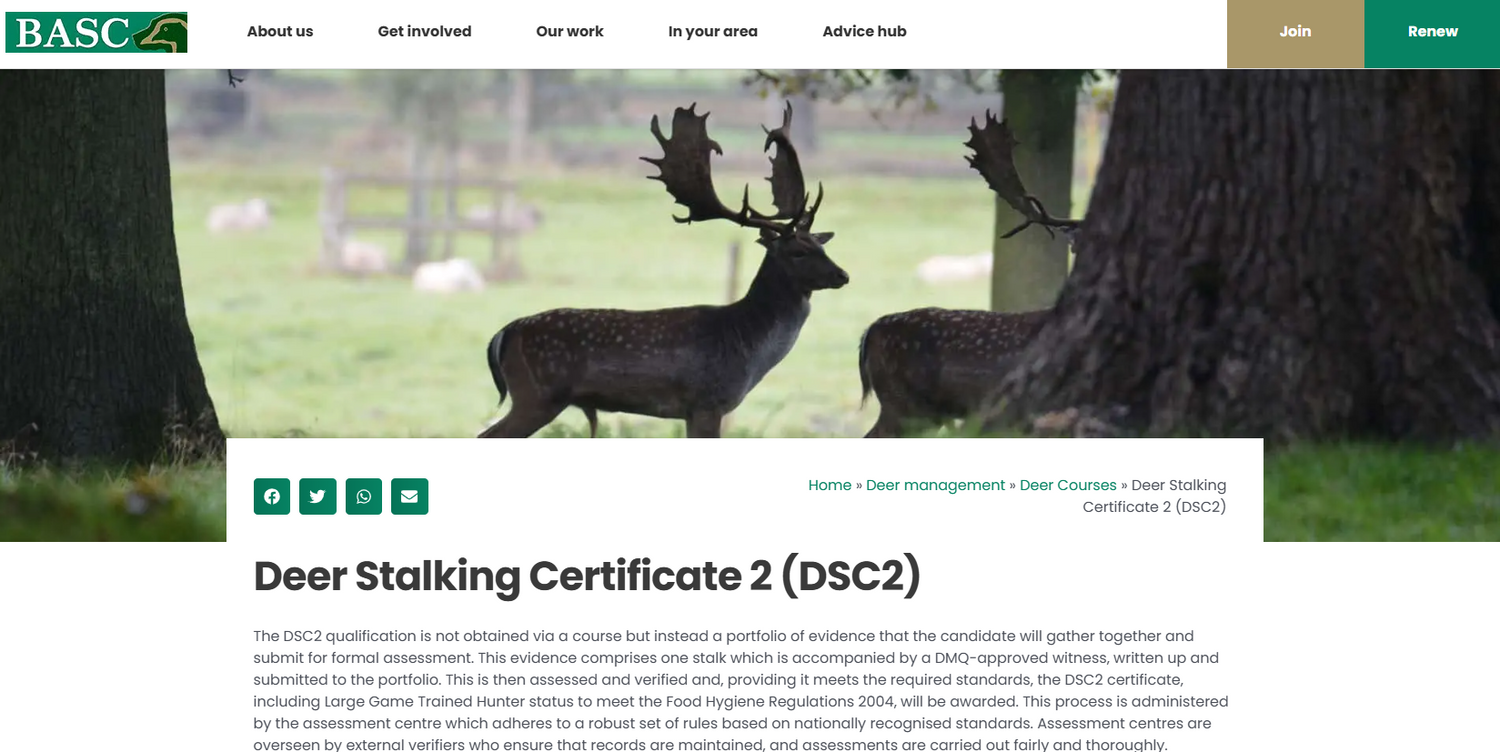
You can visit https://basc.org.uk/deer/courses/dsc2/ or https://dmq.org.uk/ for further information.