There is a tendency in woodland and estate management to talk about fencing as though it is a solution in its own right. Put a line on a map, choose a height, price the materials, get it in the ground, and the deer problem is dealt with. On paper, that can feel satisfyingly simple. In practice, it rarely is.
Fencing is only as good as the maintenance behind it, and it is only as useful as the thinking that shaped it before the first post went in.
That is the part people still underestimate. A fence is not a magic line. It is a management tool, and like any management tool it can create as many problems as it solves if it is poorly planned, badly maintained, or dropped into the landscape without enough thought about what happens next.
Because once deer get inside, getting them back out is rarely straightforward.
Height matters, but it is not the whole story
A lot of fencing conversations still begin and end with height. Is it high enough. Will it stop deer jumping it. Has the contractor used the right specification. All valid questions, but they are only part of the picture.
A fence can be perfectly adequate on paper and still fail as a deer management measure if the wider design has not been thought through properly. The line of the fence matters. The landform matters. What sits either side of it matters. The pressure being applied from outside matters. The likelihood of deer already being within the enclosure at the point of completion matters. And perhaps most importantly, the route by which deer might leave, or fail to leave, matters as well.
That is where simplistic thinking starts to cost people.
A fence built without any thought to escape routes, funnels or traps can quickly turn into a holding pen rather than a protective barrier. The deer do not disappear simply because the line is now closed. If they are inside when the final section is completed, or if they find a weakness and get in afterwards, you may well have transformed an external browsing problem into an internal one.
And internal deer pressure inside fenced woodland is often far more frustrating than the pressure outside.
The real problem begins when deer are trapped in
This is the part that tends to be mentioned too late, if it is mentioned at all.
People rightly focus on keeping deer out. Far fewer spend enough time thinking about how deer get out if they are already in, or what your practical options are once they have breached the line. That is where fenced areas can quickly become a management problem rather than a solution.
A deer inside a fenced block does not behave the same way as a deer moving freely across open ground. It may push the line repeatedly. It may settle in thick cover. It may become far more difficult to approach safely. It may begin circulating along the perimeter, damaging regeneration while never quite presenting a clean opportunity to remove it. If the woodland is young, dense, awkward, or otherwise poorly designed for control, the problem can become disproportionate very quickly.
This is especially true in the sort of fragmented lowland landscapes many of us deal with, where fences often wrap around small or irregular parcels rather than large, open, easily managed blocks. The tighter and more awkward the enclosure, the harder it usually is to solve once deer are in the wrong side of it.
That is why escape routes and extraction logic should be considered at the design stage, not as an afterthought once browsing starts inside the fence.
Good fencing design needs to think like deer
This is one of the simplest and most overlooked principles in the whole discussion. Fencing works best when the designer has spent at least some time thinking about how deer actually use the ground.
Where do they naturally move. Where do they cross. Where do they hesitate. What do they avoid. Where does the topography guide them. Where will pressure build if one route is blocked. Where would an animal try to leave if suddenly enclosed.
Those questions matter because deer do not respond to fencing in abstract. They respond to it physically, in relation to cover, slope, visibility, pressure and habit. A fence line that looks neat and efficient on a map may run directly across an established movement corridor and create repeated challenge points. A fence that ignores natural topography may force pressure into the weakest section. A design with no planned escape logic may leave you relying on luck and patience once deer are in the wrong place.
This is where funnels and traps come into the conversation.
Used properly, they are not simply clever additions. They are often the difference between a fenced area remaining manageable and becoming a long-term source of frustration. If you know deer use certain lines, then design should acknowledge that. If you know extraction or removal will be difficult once the line is closed, then build for that reality before the problem begins.
A fence should not only exclude. It should also support management.

Maintenance is the part everybody says matters and too few actually plan for
Even a well-designed fence will fail if nobody is really maintaining it.
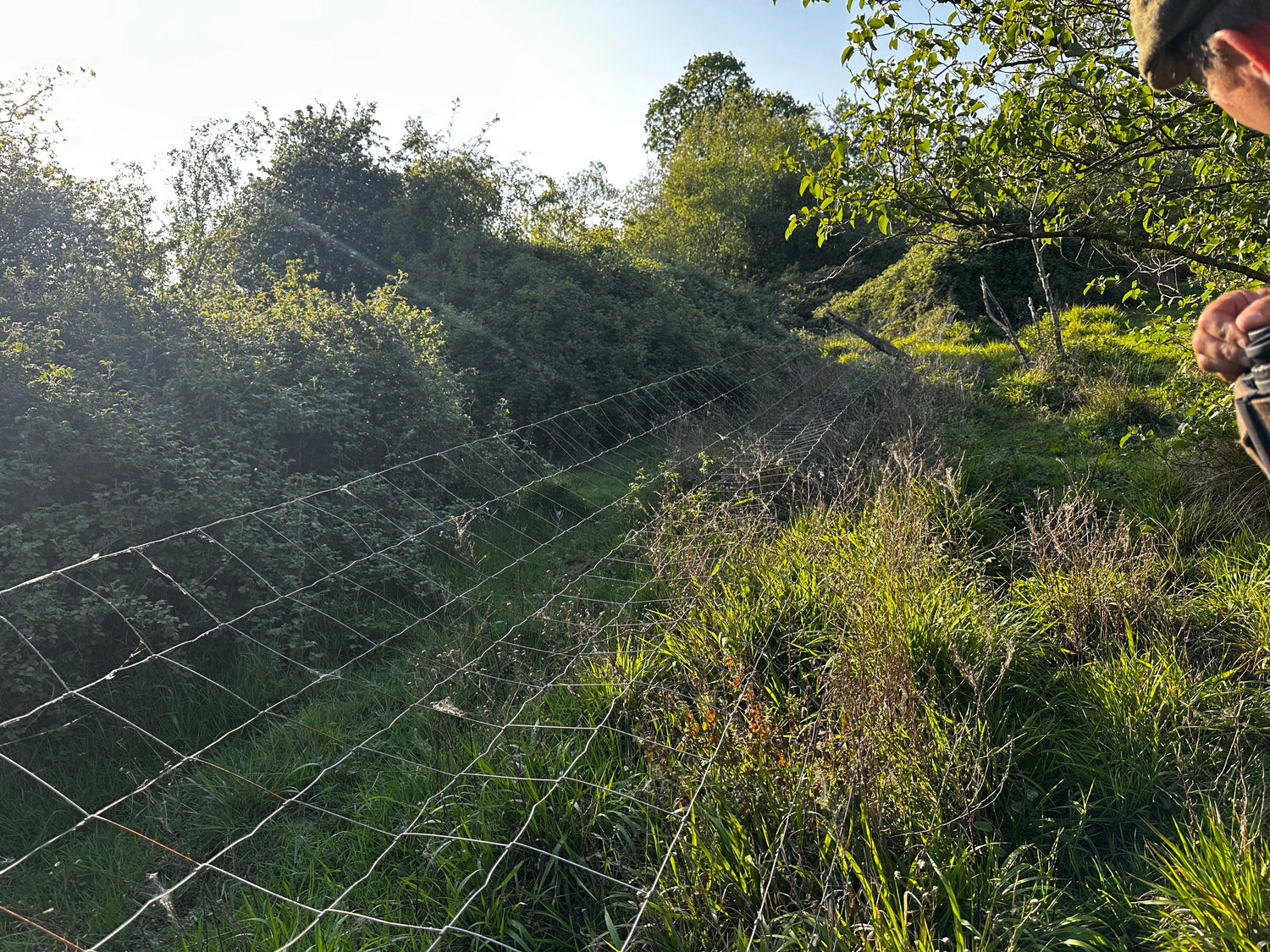
This is another part of the conversation where people often nod in agreement without fully pricing in what it means. Deer fencing is not something you install and then admire from a distance twice a year. It requires inspection, especially after weather, fallen branches, public interference, livestock contact, ground movement, or any period where pressure on the line may have increased. Small weaknesses do not stay small for long. A low section, a lifted edge, a damaged join, a gateway issue, a washout underneath, all of these can become entry points quickly enough.
And once deer learn where a fence is weak, they tend to keep testing it.
That is why fencing is only as good as the maintenance behind it. If the estate or landowner is not prepared to monitor it properly, repair it promptly, and treat it as an active management asset rather than a one-off capital item, then the fence will eventually stop behaving like a solution.
It will simply become another line of false reassurance.
Fencing can move pressure as much as it removes it
There is another truth that deserves more honest discussion. Fencing does not make deer disappear. It redistributes pressure.
That is important because some woodland owners still think in terms of “the fenced area” as though the rest of the landscape will remain unaffected. It rarely works like that. Excluding deer from one area may increase pressure on adjacent woodland, margins, crops or unmanaged cover, particularly where the wider landscape is fragmented and deer are already working through limited routes and refuge.
That does not mean fencing is wrong. Far from it. It means fencing has to be seen as one tool inside a wider deer management system. If there is no pressure reduction beyond the fence, no coordination with neighbouring ground, and no thought about where displaced deer pressure is likely to land, then the fence may protect one problem area while aggravating another.
Again, the issue is not the fence itself. It is the tendency to expect fencing to solve a landscape problem on its own.

Young woodland and regeneration blocks are especially vulnerable to poor design
This is where mistakes become expensive quickly.
New planting, natural regeneration sites, restocking areas and sensitive recovery blocks are usually fenced because they are the parts of the estate least able to tolerate browsing pressure. That makes sense. But it also means that when the fence underperforms, or deer get inside, the damage can become disproportionate very quickly. The very areas you were trying hardest to protect are often the least forgiving of internal pressure.
That is why design and maintenance need to be better, not merely adequate, around young and vulnerable woodland. It is also why monitoring inside the fence matters just as much as walking the outside. Too many people inspect the line and assume that if the fence appears intact, the problem must be outside. In reality, some of the worst fencing failures are internal ones that go unnoticed until the browsing pattern makes the truth unavoidable.
By that stage, the fence may still look fine from the ride.
The best fencing projects begin with management, not materials
This, in the end, is probably the clearest way of putting it.
The strongest deer fencing projects begin with management thinking, not material thinking. Yes, specification matters. Yes, height matters. Yes, route matters. But the real question is broader. What is this fence supposed to achieve, how will it be maintained, what happens if deer are already inside, how will they be removed, where will pressure go instead, and who is responsible for the whole system once the contractor has left.
If those questions are not being asked, the project is already weaker than it should be.
And this is where estates often need a more grounded conversation before they spend the money. Fencing can be valuable. In many cases it is necessary. But necessity does not remove the obligation to design it properly. In fact, it increases it.
Effective deer fencing is about far more than height and route. It is about what happens before the fence goes in, what happens after it is completed, and what happens when the first deer is standing on the wrong side of it.
Fencing is only as good as the maintenance behind it. Once deer get inside, getting them back out is rarely straightforward. If escape routes, funnels or traps are not considered at the design stage, fenced areas can quickly become a management problem rather than a solution.
That does not mean fencing should be avoided. It means it should be treated seriously, as part of a wider deer management system rather than a neat standalone answer. Because the best fence in the world is still only a line in the landscape unless somebody has thought carefully about how the animals, the ground, and the management will all interact once it is there.