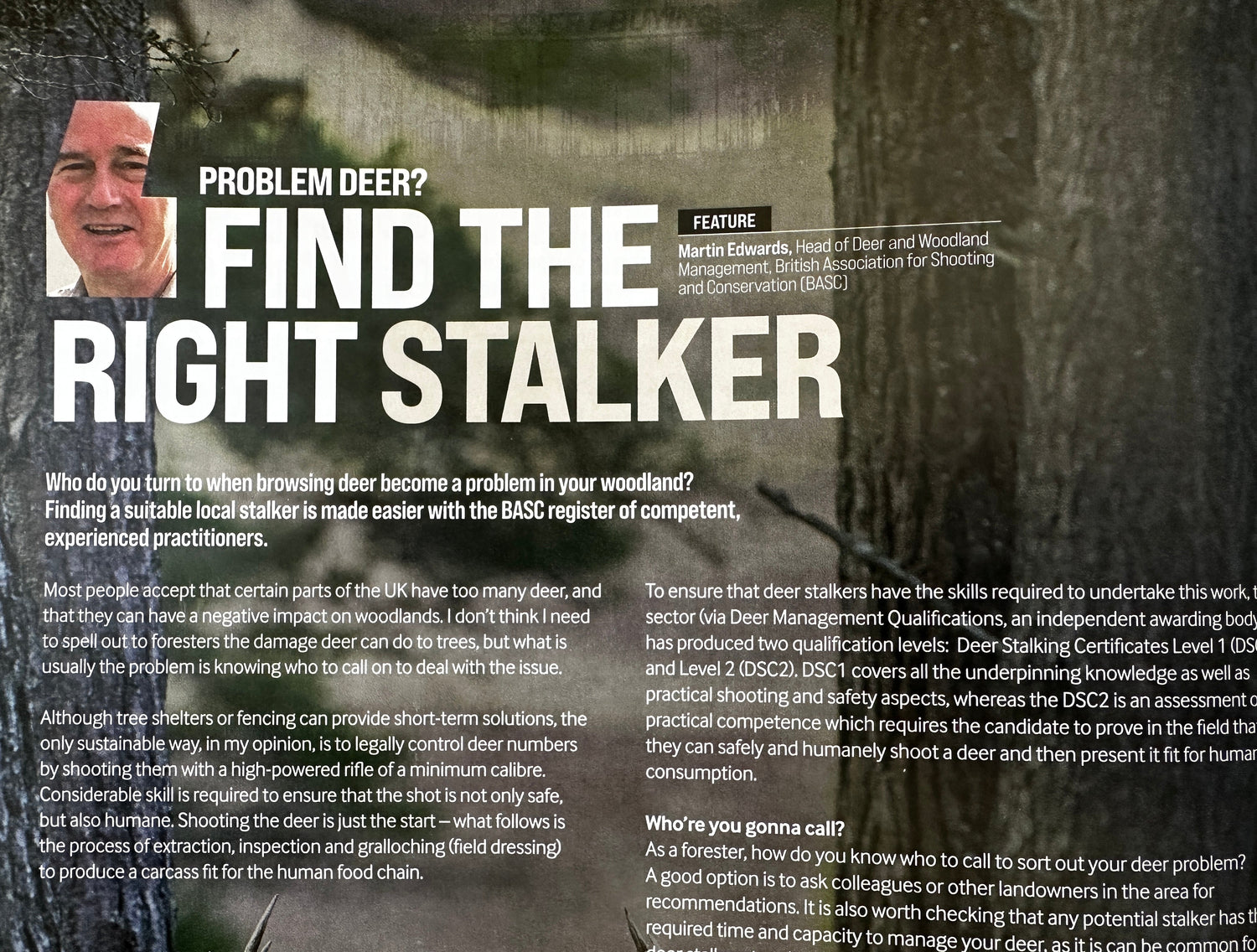
In the latest ICF magazine, Martin Edwards – BASC’s head of Deer and Woodland Management – sets out a straightforward question for foresters and landowners: who do you call when browsing deer become a problem, and how do you know they are up to the job? He points readers to the BASC Register of Competent Deer Stalkers and underlines the need for training, assessment and professionalism.
https://charteredforesters.org/forestry-arboriculture-news
On that central point, I have no argument at all. The sector needs more competence, more scrutiny and more honesty about who is genuinely capable of managing modern deer pressures. Where I think we need to be careful is in the way we talk about how effort is measured, particularly in the context of public money through schemes such as CWS1: Deer control and management.
If we are not thoughtful, we risk sending a message that hours on the ground and raw cull numbers are the main gateways to the public purse. Any professional stalker knows that is not quite the truth, and it is certainly not what the taxpayer is supposed to be buying.
What CWS1 Is Really For
CWS1 sits inside Countryside Stewardship Higher Tier and pays a fixed rate per hectare over ten years where deer are harming priority habitats or where there is significant pressure. The published aim could not be plainer: to reduce the harm deer are causing to priority species and habitats, and to allow those habitats to thrive again.
To secure and retain that support, agreement holders must do more than simply say “we went out a lot and shot some deer”. The guidance for the deer control supplement makes clear that a deer management plan, cull data, survey reports, details of exclosures and a habitat impact activity are all required.
In other words, the grant is trying to buy a change in condition, not just a flurry of activity. The outcome is supposed to be better woodland structure, improved regeneration and healthier, more resilient habitats, not merely a tired stalker and an impressive tally sheet.

Hours On The Ground: Necessary, But Not The Measure Of Value
Everyone who has done any serious deer work knows that hours matter. They matter because deer move when they move, not when the office diary says they should. They matter because dawn and dusk are not negotiable, because night licences require unsociable hours, and because difficult ground does not suddenly become easy because you have limited time.
The temptation, especially when we begin to talk about grants, is to turn that reality into a metric: “X hours per hectare per year” or “Y outings per month”. It feels reassuringly concrete. It sounds like diligence.
The trouble is that hours are a cost, not a benefit. If we promote them as the primary gateway to public funding, we risk legitimising exactly the thing landowners and the public are rightly suspicious of: paid “armed walks in the woods” where very little actually changes on the ground.
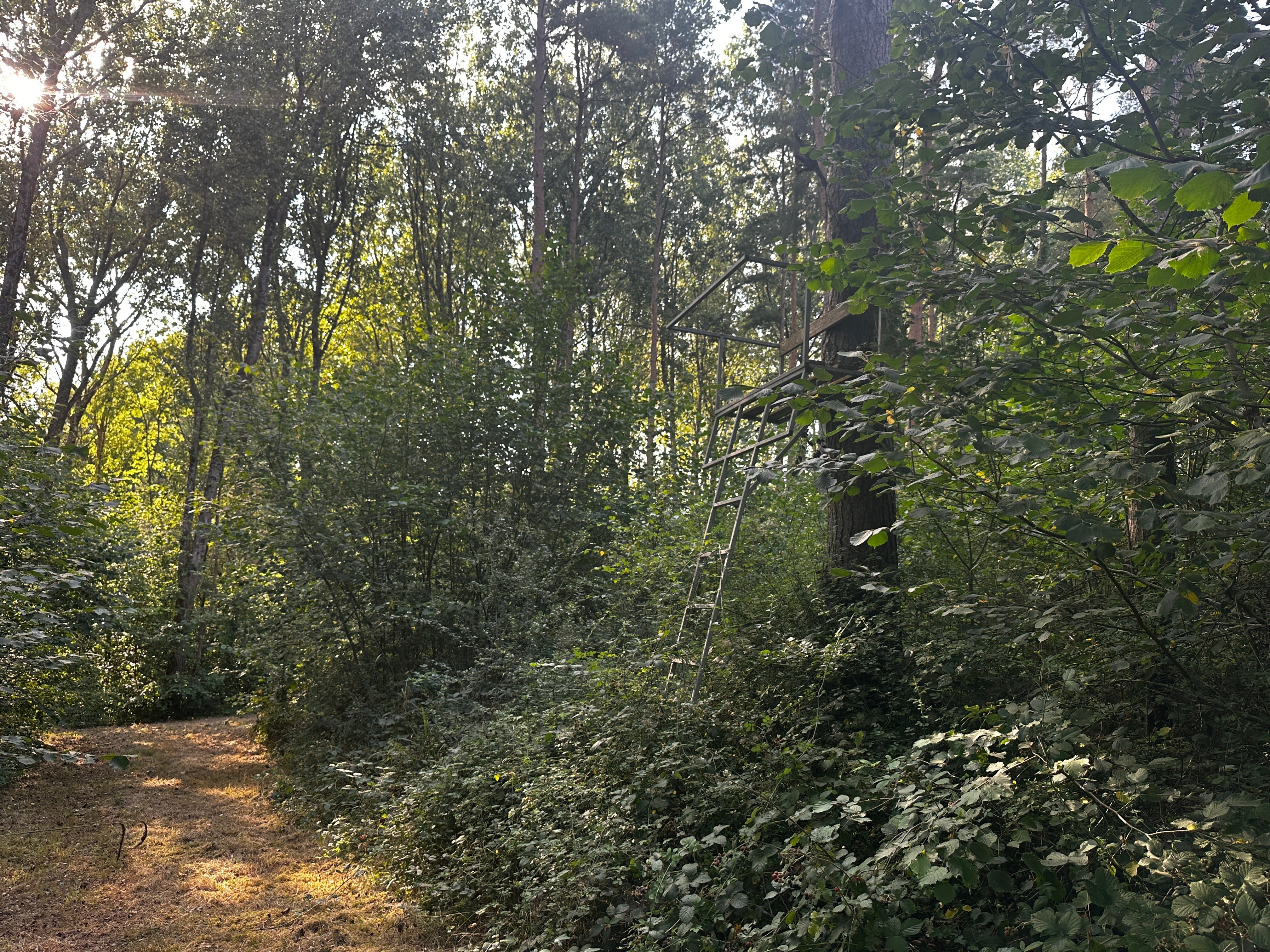
A stalker can sit in a high seat for four hours and contribute almost nothing to woodland recovery if they are in the wrong place, targeting the wrong animals, or unwilling to address the awkward corners where the real damage is being done. Another stalker can, in the same time, remove two key animals in a heavily browsed block and transform the trajectory of regeneration. The stopwatch does not distinguish between the two.
Hours are a necessary input. They are part of the story when we cost work or design contracts. But they are a poor headline measure of whether CWS1 money has been well spent.
Cull Numbers: Essential Evidence, Not The Whole Picture
Something similar can be said about cull numbers. The CWS1 and WS1 guidance does require demonstration that acceptable levels of culling are being achieved and maintained. Forestry Commission operations notes talk explicitly about “demonstrable increases or maintenance of acceptable levels of deer culling from the start of your agreement”, backed up by cull data.
That requirement is sensible. It closes the door on paper plans with no real action behind them. If no deer are ever removed, in a context where they are clearly suppressing regeneration, then the grant has been misused.
But raw numbers on their own can mislead just as easily as hours can. A large cull taken repeatedly from the same easy fields, or from the safest and most accessible rides, may leave sanctuary blocks untouched and browsing pressure on sensitive habitats almost unchanged. An apparently modest cull that is tightly targeted at does in key compartments, coordinated with neighbours and backed by exclosure evidence, may deliver far more ecological benefit.
If we talk about cull numbers as if they were the primary badge of competence, we invite a numbers game. We risk creating incentives to chase volume rather than to think carefully about structure, sex and age balance, species differences and local ecology. We risk rewarding those who can collect carcasses most efficiently, rather than those who can demonstrate that their work has allowed woods to recover.
Cull data is essential, but it is a piece in a larger pattern. The purpose of CWS1 is not to turn estates into production lines. It is to tip the balance back in favour of trees and ground flora that have been eaten down for too long.
What The Public Should Expect In Return
CWS1 is, quite literally, public money. It is paid out in ten-year commitments at around £105 per hectare per year, often across hundreds of hectares.
The public has a right to ask what they are buying. Hours and body counts are easy to communicate, but they are not what most people care about when pushed.
What a reasonable member of the public wants to know, if they are prepared to think beyond the immediate discomfort of culling, is something closer to this: that woodland which used to be bare between hip and canopy now has saplings coming through; that bluebells, orchids and shrubs have returned where they were missing; that songbirds and invertebrates have more cover; that the deer which remain are in better condition and less stressed; and that young trees planted with their tax money are not being eaten as quickly as they go in the ground.
Those are not romantic wishes. They are exactly the habitat outcomes that the government’s own guidance points towards when it frames deer control supplements as tools for protecting priority habitats and supporting woodland resilience. When the Forestry Commission asks for deer surveys, exclosures and habitat impact activities, it is quietly acknowledging that the real test is what happens to the plants, not to the spreadsheets.
If we, as a sector, choose to talk primarily about time served and carcasses lifted, we obscure the very results that give us our social licence to operate.

Towards Impact-Led Evidence
This does not mean throwing away quantitative measures. It means aligning them with the right questions.
Cull data remains essential. It tells us whether we are acting at all and whether our efforts are remotely proportionate to the known population. Since launch, deer and grey squirrel supplements have been applied across tens of thousands of hectares; at that scale, a complete absence of numbers would be a red flag.
Hours of effort also have their place. They help explain why a particular cull figure was hard won on difficult ground, or why a low-density population in complex terrain required night work and significant travel. They inform costings and contracts. They protect stalkers from the unrealistic expectation that everything can be done in a few comfortable evenings.
But both of those inputs should sit alongside direct measures of impact. That is where exclosure plots, regeneration surveys, browse indices and photographic records come in. If the same plots move slowly from “severely browsed” to “recovering” over the lifetime of an agreement, if woodland management plans can show an increase in sapling density and structural diversity, then we have something honest to point to when anyone asks what CWS1 has delivered.
The point here is not to drown landowners in yet more paperwork. It is to remind ourselves that the paperwork we already have – PA7 species management plans, woodland management plans, habitat impact surveys – is meant to be a reflection of reality, not a substitute for it.
The Risk Of Sending The Wrong Signal
Martin’s article, quite rightly, encourages foresters to think carefully about who they bring onto their ground and to look for evidence of competence, training and experience. In a world where anyone can buy a thermal scope and call themselves a “deer manager”, that message needs repeating.
Where I hesitate is around the idea that hours or headline cull figures might be presented, however unintentionally, as the main yardsticks for grant justification. The danger is not academic.
Many estates are already wrestling with funding gaps in woodland management. CWS1 appears as a rare bright spot: a long term income stream that can help pay for professional input. If we tell people, explicitly or implicitly, that the gateway to that stream is “X hours per hectare” and “Y animals per year”, we risk encouraging exactly the wrong kind of behaviour. Long, unproductive nights spent in comfortable high seats just to tick a box. Numbers chased in the easiest fields while awkward steep banks and wet ghylls remain refuges. Contracts that reward visible effort over thoughtful planning.
None of that is what Martin is arguing for, and it is certainly not what BASC, the Forestry Commission or Natural England want to see. But messages are interpreted, not just written. We have to be careful about what we appear to value.

Support, Standards And The Purpose Of The Grant
There is no doubt the industry needs support from government. The scale of deer impact in parts of England is beyond what most private estates can address on their own. Grants like CWS1, if used as intended, can lift the entire baseline of practice. They can pay for proper plans, structured culls, better training and coherent cooperation between neighbours.
But that will only happen if we remember what the grant is for. It is not there simply to make life easier for stalkers, however competent. It is there to improve woodlands, to protect the public investment in new planting, to safeguard biodiversity gains and to bring deer populations back into a relationship with habitat that is sustainable over the long term.
Professional stalkers, whether recreational or full time, should be leading that conversation. We know better than anyone that not every outing produces a carcass. We know that some of the most important decisions we make are decisions not to shoot. We know that competent management sometimes means leaving animals where they are, sometimes means taking out one matriarch rather than three followers, sometimes means walking away from a tempting shot because a footpath is just out of sight.
If we reduce all of that complexity to “how many hours did you do” and “how many deer did you shoot”, we betray the very professionalism we are trying to promote.
In Defence Of A More Honest Metric
So yes, by all means, find a competent stalker. Use registers, ask for references, look for qualifications, ask awkward questions about backstops and gralloch hygiene. Those are all sensible gates to put between your woods and the nearest keen volunteer.
But when you start to think about CWS1, and about what you will point to in years three and five when someone from the Forestry Commission or Natural England asks whether the money has been well spent, remember this: the real evidence will not be the timesheets. It will be the young oak that has finally made it past browsing height, the coppice that now throws a proper flush instead of a hedgehog of chewed stems, the bluebells that have spread back into rides, the nightjar or warbler that has returned to a compartment that used to be bare.
Hours and numbers will always be part of the story. They are the scaffolding that holds up serious work. But the work itself – the thing we owe to the public purse, to landowners, and to the deer and woods we claim to care about – is measured in habitat.
On that, I suspect Martin and I would find ourselves in agreement. The challenge for all of us is to make sure our language, our contracts and our grant schemes reflect it.